
BLOGS
What Happens After Your Viva: Minor vs Major Corrections Explained
Have completed your PhD viva and received corrections? Get to know what minor and major corrections are, what follows and how to deal with examiner feedback without causing a more difficult process than it should be.
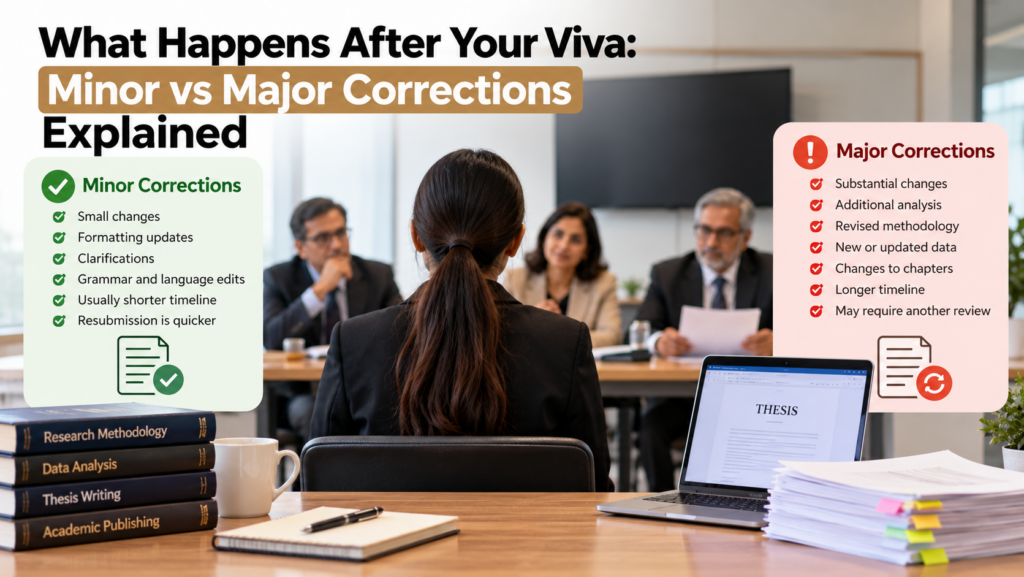
The viva is over. You have answered the questions, justified your decisions and are likely to have rehearsed at least three of your replies in your mind before you have even stepped out of the building. Then the result you have passed, but there are corrections to be made.
In the case of most PhD students, it is here that the relief is intermingled with a different emotion altogether. What are the examiners referring to by minor corrections? How minor is minor? When the result is major corrections, does that imply that something went wrong? What is the time period of the changes, and when will you be able to refer to the thesis as complete?
The first thing to be aware of is that corrections following a viva are usual. It is possible to have a thesis that is good enough to qualify as a degree but requires revisions till it is the final approved version. Those changes may be as basic as correcting references and some clarification of paragraphs, or may be more serious rewriting and interpretation. The tag that is placed on the result provides you with a clue of the scale, however, your examiner report provides you with what is really involved in the work.
One significant complication exists as well: not all universities have the same vocabulary. Others officially differentiate between minor and major corrections. Some of the categories that are used by others include minor amendments, editorial corrections or resubmission. So although this guide will give you an idea of what these outcomes tend to mean, the regulations of your own university and your official examiner report will always take precedence.
So, What Actually Happens After the Viva?
During the post-viva hours, one can be tempted to begin thinking of the corrections right away. Try not to rush. You will be given an informal clue of the outcome at the end of examination, but what you have to work with is the written outcome.
A report or a list of changes that should be undertaken will usually be prepared by your examiners. This could be in a short time or when the official examination procedure is over depending on the university. Read it without making any edits. Read it again then with the thesis by your side.
Part of the requests will be self-evident. There is not much to interpret about the corrective note about the citation on page 74. Other ones may be wider: reinforce the discussion of a weakness, explain the choice of method, be more critical of a specific literature, or reformulate a conclusion to be more indicative of evidence.
This is why the examiner report will be more important than the poignancy of the label. One candidate may be given a lengthy list of simple tasks which constitute minor corrections and another candidate may be given few comments which involve deep thinking.
The official procedures are different as well. UCL, for example, gives minor corrections as a typical post-viva consequence, and provides candidates with the examiner reports with a directive as to who will verify the amendments. Corrections, major corrections and referral are recognized as minor Oxford separately recognises major and referral. These variations serve as a good reminder that you should not compare your own result with that of a viva story of someone.
Minor Corrections: What ‘Minor’ Usually Means
Minor corrections are the ones that are usually accepted as the foundations of the thesis. It is not proposing to you to come up with a new research project, or to begin the doctorate all over. The investigators have pointed out the areas which require to be addressed before the final copy can be passed.
Common examples of such changes include tightening an argument, fixing a calculation, making a section wording better, fixing some inconsistent terminology, providing a pertinent reference, clarifying a methodological decision, making a change to a table or a figure, or fixing instances where the conclusion claims slightly more than the evidence backing it.
There are developments that may appear larger when on paper than they do in reality. A reviewer could say, the review in Section 5.4 should be more actively involved with new literature. It sounds much more serious than a typo, but it can also be a narrowed down task: read through some related studies, make decisions about how they influence the interpretation and go through two or three paragraphs in revision. This does not always imply that one has to rewrite the entire chapter.
A good illustration of the breadth of the category of minor can be found at The University of Leeds Its existing instructions set a line between simple editorial and presentational corrections and minor amendments, which can involve re-writing sections to make sense, corrections of calculations, elaborating arguments, including literature and performing limited additional research, so long as the thesis does not alter the basic argument of the thesis.
The latter is handy. There are small fixes that may necessitate actual academic work. The term minor refers to the result of the examination, not necessarily the number of hours you will work in your desk.
The most appropriate reaction is to give all corrections seriously without making them bigger than what the examiner asked. When you have been requested to explain one point, explain it adequately. Don’t just go and rewrite ten pages around you, thinking you now realize you could have written out twenty more sentences in different ways.
And What About Major Corrections?
Major corrections typically imply that the thesis is to be worked on in greater detail before it can be switched to final approval. This can include a substantial rewrite, its further investigation, better theoretical elaboration, or even extensive revisions to portions of the discussion, or a series of interrelated revisions that cannot be addressed by minor edits.
The term may sound scary, particularly, right after a viva, yet one should not take it without verifying the regulations of the university. Oxford, for example, now considers major corrections as a formal consequence which is independent of both minor corrections and referral. Within its existing research-examination procedure, major corrections experience a more extended correction phase in comparison to minor corrections. And that is the reason why major corrections should not be immediately translated as you have to resubmit the entire PhD.
In this case, you are getting this result; start with the examiner report and not the label. What is it that is changing? Is the issue focused in a single chapter? Do the examiners request further analysis? Is the theoretical framework more appropriately linked with the findings? Are the conclusions too strong to the evidence? After you have a report broken down into separate tasks, then the job usually becomes a lot less daunting.
There are also other sections that might be impacted by a massive correction. You might have to update the discussion in Chapter 5 and the conclusion in Chapter 6, should you modify an analysis in Chapter 4. When you change the explanation of a construct, it might be required to review the literature review and methodology to ensure it aligns. In this case, prudent planning is more important than expedience.
This is not aimed at length for the thesis. It is so that the requested parts become stronger and so that the version with revisions can still be perceived as a single piece of research.
Major Corrections and Resubmission Are Not Always the Same Thing
It is in this area that much of the online advice can be confusing. Major corrections, revise and resubmit, referral will be used interchangeably. They do not always.
In certain universities one of the post-viva outcomes is major corrections. In others, a thesis requiring significant work can be resubmitted, rather than being rejected. An example is that UCL’s published process, differentiates between minor corrections and resubmission. Resubmission involves re-entering the examination process, resubmitting the revised thesis and being re-examined in a viva by both examiners. Leeds also uses referral of a thesis which is near the required standard but still requires much work before being re-examined.
It is quite a different process than an examiner merely verifying a set of corrections.
So this is why, in case you are reading this after receiving your own outcome, you need to take a look at the very wording of your result letter. Do not look into the internet about the major corrections and think that all the discussions are relevant to you. Go to your university and look up your university regulations with the exact word that they have provided.
The practical difference is important as it may influence the deadline, in which you turn in the revised thesis, who reviews it and a second viva can be realized. The formal university instructions are the last authority when it comes to the interpretation of the report and your supervisor can assist you with this.
How to Tackle Corrections Without Making Them More Stressful
After the report has been received, do not be tempted to open Chapter 1 and begin to edit at random. Nothing seems to make corrections endless as working without a system.
Write every comment of the examiners in the paper, write where the problem has been formed in the thesis and put a blank spot where you made it. In case the correction is on more than one part, note all the positions.
As an example, the examiner would question you to elaborate further on why your sampling method was suitable. You may need to change the methodology section, however, a minor modification can be made to the limitations section. Both should be indicated in your correction log.
Then determine sequence of work. Do the corrections that have knock-on effects first. Any modification to the analysis may also influence the findings, discussion and conclusion and it is therefore not worthwhile to polish the conclusion before that is done. Basic editorial amendments may be deferred until the substantive amendments are finished.
When examining, have the wording of the examiner in front of you. It is not just to make the thesis better in accordance with your current likes and dislikes. The point raised is to answer you.
Write a brief, factual description of what you fixed and where, each time you complete your correction. Instead of writing done, it is much more helpful to write revised pages 142-144 to explain the difference between perceived value and satisfaction and include additional discussion of X and Y.
To candidates, Leeds advises candidates you are to provide corrections with data that demonstrates what has been changed, which could be in the form of tracked changes or a list on its own, depending on the preferences of the examiner. Although your university may not officially require you to have a correction table, having one yourself is among the simplest methods to eliminate the chances of overlooking something.
Do Not Over-Correct a Thesis That Has Already Been Examined
The viva may make you aware of things that you would have done better to write. That is normal. You are now aware of the project better than it was when some initial chapters were written.
However, the corrections period is not a free-to-a-new-birth offer to rewrite the whole thesis.
When a clearer explanation is required by an examiner, then provide him with a clearer explanation. Should they request further literature, include the literature in a manner which enhances the argument. When they notice there is an error in a table, correct the table and verify any text that is dependent on it. Change the necessary thing and pursue its consequences on the basis of the thesis.
The last thing that you want is to open a topic that is not related and re write it just because your style has changed. Each superfluous edit offers a new possibility of a new typo, inconsistent terminology, cross-reference or reference-list issue.
This is especially crucial when you introduce new sources in corrections. New references should be formatted to correspond with the reference list and any references deleted in the process of rewriting should also be verified. In case your thesis is written in the APA style, the KM Academic Success APA 7th Edition guide may assist you in the typical problems regarding in-text citations, reference entries, presentation of DOI and URL, and overall consistency.
Consider the revised thesis to be the improved thesis under examination–not an entirely new thesis that chances to share a title.
What Happens When You Send the Corrections Back?
After you have done the work requested, the fixed thesis or correction papers generally get forwarded to the individual as indicated by your university. This can be the internal examiner or any other appointed checker in case of simple corrections. More significant consequences can be a combination of examiners or a formal re-examination of the case.
The checker is seeking to find out evidence that you have covered the points required satisfactorily. Another reason why a clean correction log comes in handy is this. You do not need to have the examiner go through a voluminous thesis in an attempt to find out what changed, you can refer them to the pertinent areas.
In case a correction has not been done satisfactorily, you might be requested to repeat it. That is not to say that all sections of the thesis are suddenly reopened. Cover the unanswered point and answer in a simple way.
Upon approval of the corrections, it is typically followed by another step: the final version of the thesis is submitted via the system of required repository or deposit required by your university. At Leeds At Leeds, for example, the thesis is laid after the internal examiner has given the corrections. UCL also requires the scholarly requirements and terminal thesis-deposit requirements must be fulfilled prior to the graduation of the degree.
This phase of administration may be anti-climaxing after several years of research, but it is important. The thesis that you defended is not necessarily the thesis which will remain the final form. The version of your paper that is corrected and approved is the one that is used to complete the examination.
A Few Things Candidates Often Worry About
A typical concern is that correction is an indication that the viva was not performed well. It is no good conclusion to make. Corrections are inherent in doctoral examination systems and minor corrections in particular is a normal product at most institutions. It is not the outcome that is important at this point but rather a comparison to the outcome of someone who claims they got through without corrections. It is doing up the piece to your own result.
Another worry is the length of the correction list. Preclude comments as a measure of seriousness. Five conceptual corrections may entail as much work as thirty editorial. Read the requirements of each item.
Applicants are also concerned about conflicting with an examiner. Most of the time the best strategy would be to know what is behind the comment and then determine the way to respond. In case a request is indeed ambiguous, talk to your supervisor and go through your university channels of seeking clarification. When told something to correct you, do not silently pass over it by slighting its expression.
Lastly, do not leave referencing, formatting and consistency until 5 minutes to submit. Substantive corrections are able to move page numbers, headings, tables and cross-references. Allow yourself, one dirty final read when the academic changes are complete.
The Last Stretch of the PhD Is Still Part of the PhD
Punishments may be unjustly untimely. The thesis has been already provided. You are already ready to the viva. You have already confronted examiners, and defended years of work. In a way, you might be emotionally complete when the university process indicates that you are not yet there.
This is why it is best to consider corrections as a specific final project and not a continuation of the doctorate. You have a list. There is an expiry date. You have a definite goal to pursue.
Divide the report into the small sections, address the changes which influence other parts first, keep a record of what you have already done and request explanation at the very beginning in case something really does not make sense. do not fret weeks over the term, major corrections, when the report of the examiner can tell you just what must be done.
Should you require assistance in interpreting academic advice, in developing research writing or assessing the form and integrity of a dissertation or thesis, KM Academic Success provides research and academic guidance is there to assist the researcher and not to take the place of his or her judgement. It is important at the corrections stage: the thesis must still sound like your research, your reasoning and your academic voice.
Final Thoughts
Life after the viva may be disorienting since you are not complete and at the same time complete. The analysis is complete, and yet the termination thesis might be awaited to be polished to complete the degree successfully.
Minor corrections typically imply targeted adjustments to a thesis with an already accepted central research. In the case of major corrections, to which category belongs, more substantial revision is generally involved. Many universities have a different process, which is referred to as resubmission or re-examination. Precise definition and dates will be determined by your institution, and therefore you must always read your result letter with the current regulations.
Then the practicality step takes place. Understand each comment. Make a correction log. Make the change. See what it affects further. Make a note of where you were. Revise the final work and deliver it by the proper channel.
You do not have to redefine the whole PhD with each new opening of the correction list. You must demonstrate that you were aware of the issues of the examiners and acted on them thoughtfully. As soon as those changes are accepted and the final version of the thesis is deposited, the document which you have been carrying all this time finally turns out to be the final one.
FAQs About Post-Viva Corrections
Does minor corrections mean I passed?
In most systems, small corrections imply that the examiners find the thesis fit to the degree with the changes requested. The award is usually not filled in until such corrections have been accepted and the end submission prerequisites are fulfilled.
How long do corrections take?
There is no universal time propinquity. The correction times can vary according to universities. Refer to the deadline in your formal outcome as opposed to using the experience of another student or an old online discussion.
Are major corrections the same as failing?
No. In the case where a major-corrections outcome is a formal outcome of a university, the outcomes are not necessarily equivalent to failure. Oxford, for example, now separates major corrections, not including referral. The outcome is what it means to you based on your institution and examiner report.
Will I need another viva?
Minor corrections normally do not require a second viva. Another oral examination might be required on a referral or resubmission depending on the regulations of the university. The process that is applicable to you should be described in your formal outcome.
Should I use tracked changes for my corrections?
Adhere to the format asked by your examiner or university. Others like examiners favor a tracked changes version; others a clean corrected thesis and a separate response document which indicates what was changed and where.
Helpful Resources
KM Academic Success — APA 7th Edition Guide
Need Academic Guidance?
KMAS can support thesis planning, chapter structure, literature-review organisation, methodology alignment, supervisor-feedback planning, referencing, formatting, and revision strategy. The aim is to make the next academic task clearer and more manageable while keeping the student’s own analysis, argument, and authorship at the centre