
BLOGS
How to Break Down a Thesis Into Weekly, Achievable Goals
Learn the difference between working with a coach and an editor, what each professional does, and how coaching and editing can support your writing and academic goals.
When students reach the middle or final stages of a thesis, dissertation, or major research project, they often know they need help but are not sure what kind of help they actually need. One student may be struggling to organize a literature review. Another may have a complete draft but wants the language checked. Someone else may understand the research but keeps missing self-imposed deadlines and does not know how to turn supervisor feedback into manageable tasks.
These problems may sound similar because they all involve academic work, but they require different forms of support.
Two services that are often confused are academic coaching and editing.
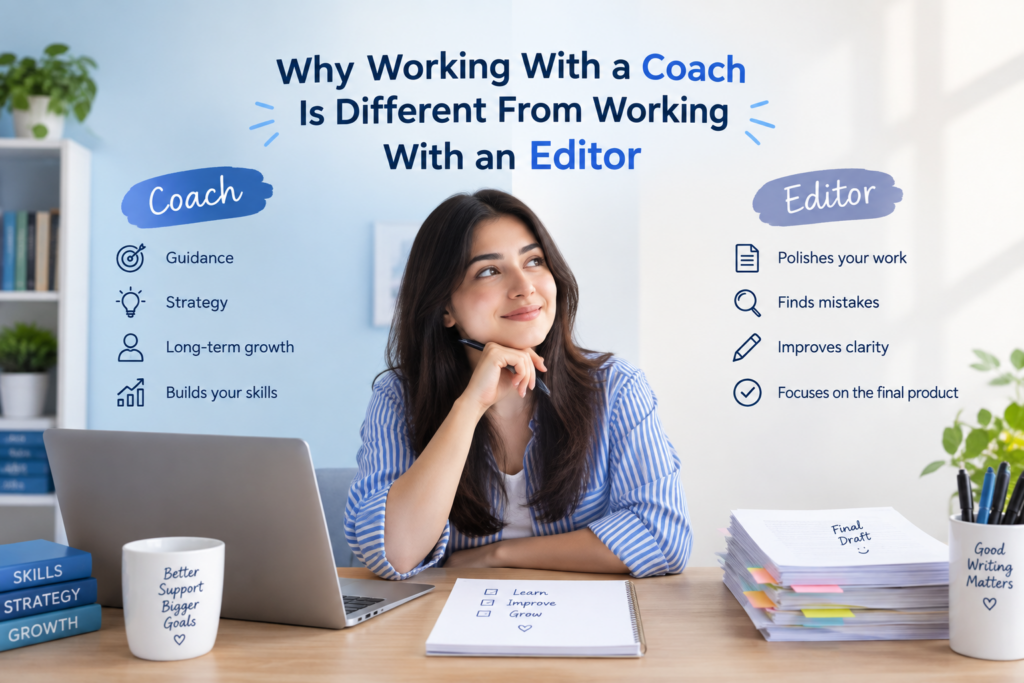
A coach primarily works with the student and the process. An editor primarily works with the document within whatever limits are permitted by the institution and applicable academic-integrity rules.
That distinction matters. Choosing the wrong form of support can lead to frustration, wasted money, unrealistic expectations, or, in more serious cases, academic-integrity concerns.
Understanding what each professional actually does makes it much easier to decide which type of support fits the stage of your work.
The Simplest Difference: Process Versus Product
The clearest way to understand the distinction is to ask where the primary attention goes.
Academic coaching focuses mainly on the process of doing the work.
Editing focuses mainly on the written document that already exists.
A coach might help you decide how to break Chapter 2 into manageable sections, establish a writing routine, understand why you keep avoiding revisions, prepare questions for your supervisor, or create a plan for responding to feedback.
An editor may work with a completed or advanced draft to improve clarity, consistency, grammar, punctuation, formatting, or other permitted language-level elements.
The boundary is not always perfectly sharp because different services use different terminology. This is why students should always ask what is actually included rather than relying only on a job title.
However, process versus product is a useful starting point.
What Does an Academic Coach Actually Do?
An academic coach helps you work more effectively on your own academic project.
The emphasis should remain on your thinking, your decisions, and your work.
A coaching conversation might involve questions such as:
What are you trying to accomplish in this chapter?
What feedback did your supervisor give you?
Which part of that feedback is unclear?
What is preventing you from starting?
Which task needs to happen before the next one?
What would a realistic target look like this week?
The coach does not need to provide the answers to every research question.
Instead, effective coaching helps you create enough clarity to make the next decision yourself.
This approach is similar to the developmental support offered through many university writing centres. George Mason University, for example, describes graduate writing consultations as opportunities to discuss ideas, organization, focus, revision strategies, disciplinary writing conventions, and ways to improve writing productivity. https://writingcenter.gmu.edu/for-graduate-students/graduate-consulting
Coaching Can Begin Before You Have a Polished Draft
One major difference is timing.
You do not need a finished document before coaching can be useful.
Students may seek coaching while selecting or narrowing a topic, planning research, developing a literature review structure, working through methodology decisions with their supervisor, organizing data-analysis tasks, building a writing schedule, or preparing for major milestones.
The coach is supporting the process through which the document is produced.
This can make coaching particularly useful when your problem is not the quality of an existing sentence but difficulty moving the project forward.
For example, an editor cannot copyedit a chapter you have not written.
A coach can help you understand why the chapter has not been written and create a realistic plan for drafting it.
What Does an Academic Editor Do?
An academic editor normally works with text that already exists.
The exact scope varies according to the type of editing, institutional rules, country, discipline, and agreement between the student and editor.
Professional editing can include language-level improvements such as grammar, punctuation, consistency, clarity, formatting, references, or style.
However, thesis editing is often subject to strict academic-integrity boundaries.
The Institute of Professional Editors’ current guidance explains that professional thesis editing must respect the independence of the student’s research and identifies responsibilities for students, supervisors, and editors. https://www.iped-editors.org/about-editing/academic-editing/
The University of Melbourne, for example, permits professional editing within defined limits and emphasizes that the thesis remains the student’s own work. https://gradresearch.unimelb.edu.au/preparing-my-thesis/writing-and-preparing-your-thesis
Students should therefore check their own university rules before engaging an editor.
Editing Is Not the Same as Rewriting the Thesis
This distinction is particularly important.
A professional academic editor should not become the author of your thesis.
Your argument, interpretation, analysis, research decisions, and scholarly contribution must remain yours.
Editing may make existing writing clearer.
It should not quietly replace your intellectual work with somebody else’s.
This is why institutional rules matter.
The allowable level of intervention can differ depending on the university and the nature of the work.
If you are unsure, ask your supervisor or consult your institution’s academic-integrity guidance before sending a thesis to an external editor.
A reputable editor should also be willing to define the service clearly before beginning.
Coaching Is Not Ghostwriting Either
A coach should not write your thesis for you.
The role is developmental.
A coach may help you create an outline, question your assumptions, identify gaps in your plan, discuss strategies for revision, or help you understand what a supervisor comment is asking you to reconsider.
But the academic work remains yours.
This is an important distinction because genuine academic coaching aims to strengthen your ability to manage and improve your own research.
If somebody promises to “coach” you by writing entire chapters, inventing analysis, creating findings, or completing assessed work on your behalf, that is no longer meaningful coaching.
The label used by a service matters less than what the service actually does.
A Coach Can Help When You Feel Stuck Before Writing
Imagine you have spent two weeks telling yourself that you need to begin the discussion chapter.
You open the document, read several paragraphs, become uncertain about the structure, and close it again.
The problem may not be grammar.
You may need to identify what the chapter is supposed to achieve, how the findings connect to the research questions, which literature needs to be revisited, and what order the discussion should follow.
A coach can help you break that problem into decisions.
Once the plan becomes clearer, writing often becomes easier.
An editor, by contrast, becomes more useful once enough text exists to edit.
An Editor Can Help When the Argument Exists but the Writing Needs Attention
Now consider a different situation.
Your full thesis is drafted.
Your supervisor is satisfied with the overall research direction, but the document contains inconsistent terminology, awkward sentences, punctuation problems, formatting issues, or repetitive wording.
That is much closer to an editing problem.
The intellectual work largely exists.
The remaining challenge is presentation.
George Mason University’s writing resources distinguish revision from editing, describing revision as work on larger concerns such as argument and development while editing deals more directly with language and errors. https://writingcenter.gmu.edu/writing-resources/general-writing-practices
Understanding that distinction can help students seek support at the right stage.
Coaching Often Focuses on Decisions
A thesis involves hundreds of decisions.
Which literature belongs in the review?
How should themes be organized?
What feedback should be addressed first?
How much time should be allocated to revisions?
What should be prepared before the supervisor meeting?
What can realistically be completed this week?
Students frequently do not need somebody to make all these decisions for them.
They need a structured conversation that helps them make the decisions themselves.
That is one of the main functions of coaching.
A good coach does not simply tell you what to do.
They help you understand the implications of different options while keeping responsibility for academic choices with you.
Editing Often Focuses on Consistency
A long thesis can contain inconsistencies that are difficult for the writer to notice.
You may use one term in Chapter 2 and a different term for the same concept in Chapter 5.
A heading may use title case while another uses sentence case.
Tables may be formatted differently.
British and American spellings may be mixed.
Citation presentation may be inconsistent.
An editor can identify these patterns because they are reading the document with fresh eyes.
This is particularly useful near the final stages, when the student has looked at the same pages so many times that obvious inconsistencies have become difficult to see.
A Coach Can Help You Respond to Supervisor Feedback
Supervisor comments can be academically useful and emotionally overwhelming at the same time.
You may receive statements such as:
“Needs stronger justification.”
“Develop this argument.”
“Clarify your contribution.”
“Reconsider the structure.”
The first challenge is understanding what action each comment requires.
A coach can help you separate comments into categories and create a revision plan.
For example, one comment may require additional reading. Another may require restructuring. Another may simply need clearer explanation.
The coach should not decide the research content for you, but they can help you turn a large feedback document into manageable tasks.
An Editor Should Not Replace Your Supervisor
An editor has a different role from your academic supervisor.
Your supervisor understands your research area, institutional requirements, discipline, methodology, and expected scholarly contribution.
An editor may improve readability and consistency, but should not become the authority deciding whether your interpretation of the data is academically correct.
Professional guidance on thesis editing similarly distinguishes editorial assistance from supervisory responsibility for matters involving substance, structure, and interpretation of research. https://www.iped-editors.org/wp-content/uploads/2025/07/IPEd_guidelines_for_editing_theses_July_2025-1.pdf
If an editor identifies a possible conceptual problem, the appropriate response may be to flag it for the student rather than independently rewriting the argument.
A Coach Does Not Replace Your Supervisor Either
Coaching complements supervision rather than replacing it.
A coach can help you prepare better for meetings, clarify what you want to ask, organize your response to comments, or establish a realistic work plan between meetings.
But decisions about the scholarly direction of the project ultimately belong within the student-supervisor relationship and the institution’s requirements.
George Mason University similarly describes writing consultations as complementary to feedback from faculty advisers and disciplinary colleagues rather than substitutes for them. https://writingcenter.gmu.edu/for-graduate-students/thesis-and-dissertation-consultations
A responsible coach should recognize this boundary.
Coaching Is Often More Conversational
Coaching typically involves discussion.
You explain what you are working on.
The coach asks questions.
Together, you identify obstacles, priorities, and possible next steps.
That conversation can reveal problems that are not visible in the document itself.
For example, you may discover that you are continually rewriting Chapter 1 because you are anxious about beginning data analysis.
The issue appears to be writing, but the real problem is avoidance.
An editor reviewing Chapter 1 may never see that broader pattern.
Coaching can examine how you are working, not only what appears on the page.
Editing Is Usually More Document-Centered
Editing often involves a more direct relationship with the text.
The editor reads the document closely and marks changes, queries, inconsistencies, or recommendations according to the agreed scope.
Track Changes and comments may be used so the student can review what has been altered.
The student should remain responsible for accepting or rejecting suggestions.
A professional editor can make a document significantly easier to read while still preserving the writer’s ownership.
That is why a clear agreement about scope is so important.
Coaching Can Build Skills That Transfer to Future Work
One of the strongest arguments for coaching is that the benefit can extend beyond one document.
If you learn how to break a complex chapter into manageable writing tasks, you can use that strategy again.
If you develop a better method for reading supervisor feedback, it remains useful for later revisions.
If you learn how to plan research weeks realistically, that skill can support future publications and professional projects.
The objective is not simply to solve today’s problem.
It is to improve how you approach similar problems in the future.
Editing Can Teach You Patterns Too
Editing does not have to be passive.
A thoughtful editor can help you notice recurring language problems.
Perhaps your paragraphs frequently contain very long opening sentences.
Maybe you repeatedly shift tense.
Perhaps your use of articles or punctuation follows a consistent error pattern.
When changes are visible and explained, you can learn from them.
However, this depends on the service.
A document that is simply corrected without explanation may improve the final text while teaching you relatively little.
If learning matters to you, ask how the editor communicates changes and queries.
Ask What Level of Editing Is Being Offered
The word “editing” can describe very different services.
One person may mean proofreading for spelling and punctuation.
Another may mean copyediting for clarity and consistency.
Another may include formatting and reference checking.
Do not assume.
Ask specifically what will and will not be changed.
You should also ask whether edits will be tracked, how queries will be handled, what style guide will be followed, and whether the editor has experience with academic work.
Professional bodies such as the Institute of Professional Editors publish guidance designed to clarify appropriate academic editing practices. https://www.iped-editors.org/about-editing/academic-editing/
Check Your University Rules Before Hiring an Editor
This step should never be skipped.
Universities differ in what they allow.
Some institutions permit professional proofreading or copyediting within specific boundaries.
Others have additional disclosure requirements or restrictions.
Your department may also have its own rules.
Do not assume that because a service is commercially available, it is automatically permitted for your thesis.
Review your academic-integrity policy.
Ask your supervisor if anything is unclear.
Keep a record of the assistance you receive when required.
This protects both your work and your academic standing.
Coaching Is Especially Useful When the Problem Keeps Repeating
You may notice that the same difficulty appears again and again.
You miss self-imposed deadlines.
You over-research before writing.
You become overwhelmed whenever supervisor comments arrive.
You spend too long polishing early chapters.
You avoid tasks that feel uncertain.
These are process problems.
Correcting one document will not necessarily solve them.
Coaching can help you identify the pattern itself.
Once you understand the pattern, you can experiment with a different approach.
Editing Becomes More Valuable as the Draft Stabilizes
Editing too early can waste time.
There is little benefit in polishing every sentence of a section that will later be deleted or completely reorganized.
Major structural revision should generally happen before final language polishing.
Writing guidance from George Mason University similarly emphasizes addressing higher-order concerns such as argument, content, organization, and evidence before concentrating heavily on lower-order language issues. https://writingcenter.gmu.edu/writing-resources/writing-as-process/providing-feedback-to-writers
This is why professional editing is often most efficient after the main intellectual and structural revisions are reasonably stable.
Sometimes You Need Both, but at Different Stages
Coaching and editing are not competing services.
A student may benefit from both during different stages of the same thesis.
Early in the project, coaching may help with planning, writing routines, accountability, and managing supervisor feedback.
Later, once the draft is complete and substantively approved, an editor may help with permitted language-level and consistency work.
Using both does not mean giving away responsibility for the thesis.
When used appropriately, the two forms of support address different problems.
The key is sequence.
Do not pay for detailed editing while the chapter is still likely to be rewritten.
Do not expect editing to solve a project-management problem.
A Simple Question Can Help You Decide
Ask yourself:
“Is my main problem that I do not know how to move the project forward, or is my main problem that an existing draft needs careful language-level attention?”
If you cannot plan, start, organize, prioritize, or respond to feedback, coaching may be more relevant.
If your argument and structure are already established but the final document needs consistency, clarity, proofreading, or permitted copyediting, an editor may be the better fit.
If both are true, consider the order in which the problems need to be addressed.
Usually, process and substantive revision should come before final polishing.
Look for Transparency in Either Service
Whether you work with a coach or an editor, the provider should be clear about what they do.
You should understand the service before paying for it.
A coach should be able to explain how sessions work and what responsibility remains with the student.
An editor should define the level of editing and the kinds of intervention included.
Be cautious when promises are vague.
Statements such as “We will make your thesis perfect” do not explain anything.
Clear professional boundaries are a positive sign, not a limitation.
Avoid Services That Promise Academic Outcomes They Cannot Guarantee
No coach or editor can ethically guarantee that your thesis will pass, receive a particular grade, or be approved by your supervisor.
Those decisions belong to academic institutions and examiners.
Support can improve your process.
Editing can improve presentation.
Neither can control the assessment outcome.
Be cautious of anyone who sells certainty.
Academic work contains judgment, disciplinary expectations, and institutional processes that external providers do not control.
Consider What You Want to Learn
Your choice may also depend on your longer-term goal.
If you want to become a more independent researcher, develop stronger writing habits, manage complex feedback, and improve how you approach academic projects, coaching may offer more developmental value.
If you already feel confident in those areas and primarily want a final document checked for permitted language and consistency issues, editing may make more sense.
Neither need is less legitimate.
They are simply different.
Be Clear About Your Own Responsibility
Whether you choose coaching or editing, the thesis remains yours.
You should understand the argument.
You should be able to explain the methodology.
You should know how the conclusions were reached.
You should review every suggested change.
You should be comfortable defending the work.
External support should increase your control over the project, not reduce it.
If you become unable to explain what appears in your own thesis, the support relationship has gone too far.
Final Thoughts
Academic coaching and editing can both be useful, but they solve different problems.
A coach works primarily with your process: how you plan, think, organize, prioritize, respond to feedback, maintain momentum, and develop greater independence as a researcher.
An editor works primarily with the existing document within the boundaries allowed by your institution and applicable academic-integrity requirements.
If you are stuck before writing, repeatedly missing milestones, struggling to interpret feedback, or overwhelmed by the size of the project, coaching may be the more appropriate starting point.
If the research and argument are already established and the draft mainly needs permitted language, consistency, formatting, or proofreading attention, editing may be more appropriate.
In some cases, both can help at different stages.
The important thing is knowing exactly what problem you are trying to solve.
Need Academic Guidance?
KM Academic Success provides ethical academic coaching for students working through theses, dissertations, research planning, academic writing, supervisor feedback, and major postgraduate milestones. The focus is on helping you strengthen your own decisions and academic skills rather than replacing your work. If you need support understanding where you are stuck and what your next realistic step should be, the right guidance can make a complex research project much easier to manage.