
BLOGS
What to Bring to Your Thesis Defense (Besides Confidence)
Prepare for your thesis defense with this essential checklist of documents, presentation materials, research notes, and must-have items for a successful defense.
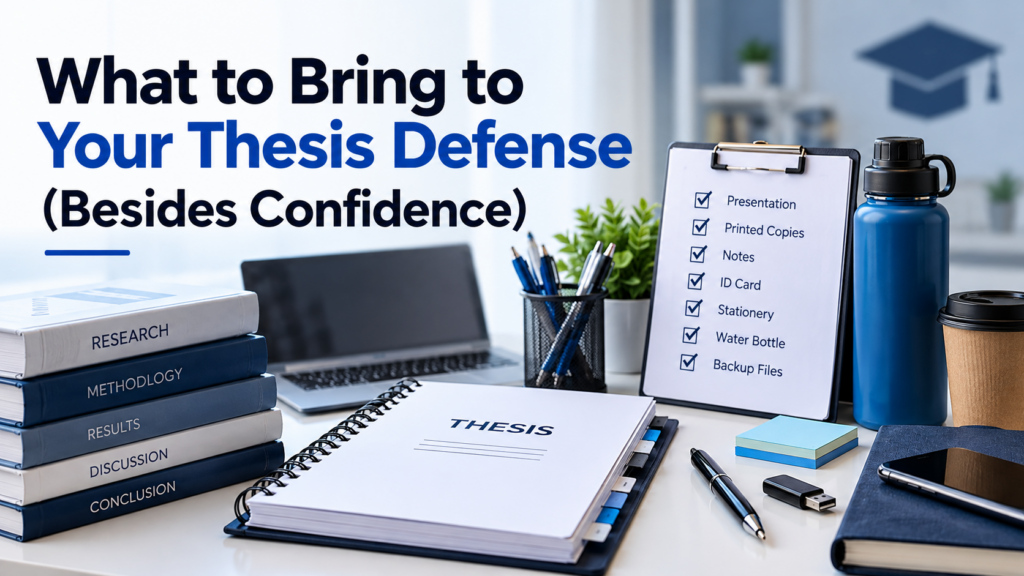
A practical defense-day checklist for the thesis copy, presentation, notes, technology, evidence, and small details that make a high-pressure day easier to manage
Confidence is useful. Preparation is more reliable. |
By the time you reach your thesis defense, you have already done the hardest part: you conducted the research and wrote the thesis. Yet the defense can still feel strangely intimidating because the format changes. Months or years of work are compressed into one conversation in which examiners can move from your theoretical framework to a table in Chapter 4, then ask why you made a methodological choice you last thought about a year ago.
This is why defense-day preparation should be practical as well as intellectual. You do not need to arrive carrying a suitcase of books, three binders of articles, and a speech for every possible question. But you do need the right materials, backups, and reference points to help you think clearly under pressure.
Current university guidance supports this practical approach. Oxford explicitly advises candidates to take a copy of their thesis to the viva, in physical or digital form. Edinburgh’s viva guidance similarly recommends bringing a thesis copy, blank paper, pens, and water. Cornell advises research presenters to check audiovisual equipment, practise aloud, prepare for questions, and have a fallback if technology fails. Duke’s defense process also shows that the defense itself is one part of a larger administrative sequence involving committee requirements, submissions, corrections, and final documentation.
The exact rules vary by university, programme, and country. Some defenses include a formal presentation; some begin immediately with examiner questions. Some are public, some private, some hybrid, and some entirely remote. Academic dress may be required in one institution and irrelevant in another. So the first rule is simple: check your own regulations before copying somebody else’s checklist.
Once the formal requirements are clear, use this guide to prepare the practical materials that make the day easier.
Before Packing Anything: Confirm the Defense Format
A strong defense checklist begins with logistics. Know the date, start time, venue or video platform, expected duration, presentation length, committee composition, whether guests are allowed, and whether you need to arrive early.
Ask whether the room provides a computer, projector, HDMI connection, clicker, whiteboard, microphone, or video-conferencing equipment. If the defense is remote, confirm which platform will be used and whether you or the chair is responsible for hosting.
Also confirm administrative requirements. Does your programme require forms, an examination certificate, a signed declaration, a printed copy, a particular binding format, or submission to a repository before or after the defense? These details differ significantly across institutions.
Do this several days before the defense, not on the morning itself.
1. Bring the Exact Version of Your Thesis That the Examiners Received
This is the most important item. Bring the same version that your committee or examiners are reading, not a later version that contains silent corrections. Page numbers and wording need to match when an examiner says, “Turn to page 137.”
Oxford explicitly advises candidates to take a thesis copy to the viva, either physical or digital. Edinburgh’s viva preparation materials also recommend bringing a printed copy.
If you prefer paper, use a copy that opens comfortably and can be annotated. If you prefer digital, make sure the file works offline and can be searched quickly. Many candidates bring both: a printed copy for navigation and a PDF as backup.
If you have noticed minor errors since submission, keep a separate errata list rather than modifying the defense copy and pretending the submitted version was different.
Defense rule: match the examiners’ pagination. |
2. Bring an Annotated Thesis – But Annotate for Navigation, Not Decoration
An annotated thesis can be more useful than memorising hundreds of pages. The purpose is to help you find important sections rapidly.
Use tabs or digital bookmarks for the introduction, research questions, theoretical framework, methodology, key results, discussion, limitations, conclusion, and any appendices likely to be discussed. Mark particularly important tables, figures, models, or equations.
Keep annotations short. A margin filled with tiny handwriting can become harder to read under pressure than the original text. Useful annotations include “RQ2 answer,” “main limitation,” “why sample size,” “alternative explanation,” and “original contribution.”
If your thesis includes complicated terminology or many abbreviations, a one-page acronym list can also save time.
3. Prepare a One-Page Research Map
Your thesis may be 60,000 or 100,000 words, but the intellectual structure should fit on one page. Prepare a private research map that reminds you how the project connects.
At minimum, include the research problem, gap, aim, research questions or hypotheses, theoretical or conceptual framework, methodology, sample or data source, main findings, contribution, limitations, and two or three implications.
This is not a script to read aloud. It is a cognitive map. If questioning becomes detailed, you can mentally return to the map and reconnect the specific question to the overall study.
For a quantitative thesis, include the main variables or models. For qualitative research, include the major themes and how they answer the research questions. For mixed methods, include how the two strands were integrated.
What the One-Page Research Map Might Contain
Element | Your one-line reminder | Why it matters in the defense |
Problem | What practical/theoretical problem motivated the study? | Helps answer ‘why this research?’ |
Gap | What was not adequately known? | Supports originality |
Aim/RQs | What exactly did the thesis seek to answer? | Keeps answers aligned |
Method | Why was this design appropriate? | Supports methodological defense |
Main findings | What are the 3-5 most important findings? | Prevents detail from hiding the contribution |
Contribution | What changes because of this study? | Central defense question |
Limitations | What can the study not claim? | Shows judgement |
Next step | What would you do differently or study next? | Shows research maturity |
4. Bring Your Presentation – in More Than One Place
If your defense includes slides, do not rely on one laptop or one cloud account. Save the final presentation locally on your laptop, export a PDF version, keep a copy on a USB drive, and store another copy in a cloud service or email account you can access.
The PDF backup matters because fonts, animations, equations, embedded media, or formatting can shift when a PowerPoint file opens on another computer.
Name the file clearly and remove older versions from the presentation folder. You do not want to open Final_Defense_v7_REAL_FINAL2.pptx while everyone watches.
If you use videos, audio, complex animations, or live demonstrations, test them on the actual equipment if possible. For a thesis defense, reliability is usually more valuable than presentation spectacle.
5. Bring the Right Adapters, Charger, and Clicker
Technology failures are disproportionately stressful when the room is already formal. Bring your laptop charger and any adapter your device needs for HDMI, USB-C, DisplayPort, or the room’s connection system.
If you own a presentation clicker and the room permits it, bring it with fresh batteries. It lets you face the committee rather than repeatedly turning toward the laptop.
Do not assume somebody else will have the right cable. Even if the university provides equipment, your own adapter can become the fastest solution to an unexpected compatibility problem.
6. Bring an Offline Backup of Key Files
Cloud storage is useful until Wi-Fi fails. Keep offline copies of the thesis, presentation, key tables and figures, and any supplementary document you expect to reference.
If your research uses software outputs, complicated models, appendices, coding frameworks, or instruments that are difficult to navigate inside the thesis, save a clearly organised backup folder.
Do not bring your entire research archive unless required. The goal is rapid access to high-value material, not a digital warehouse.
7. Bring a Small Set of Key Tables, Figures, or Models
Some defenses move quickly into detailed evidence. If you have two or three central tables, a conceptual model, a difficult equation, an interview-theme map, or a framework that is likely to be discussed, keep those items easy to access.
A large printed figure can sometimes be easier to discuss than turning through multiple thesis pages. For remote defenses, keep the relevant files open and ready for screen sharing, but avoid cluttering your desktop with dozens of windows.
The test is importance: would this item help you explain your central contribution or a complex methodological decision? If not, leave it in the thesis.
8. Bring Your Research Questions on a Separate Sheet
Research questions are the backbone of the defense. Examiners may ask about findings, methods, theory, or limitations from different angles, but many questions eventually return to whether the thesis answered what it set out to answer.
Keep the research questions visible. If a difficult question becomes highly detailed, you can reconnect your answer: “In relation to Research Question 2, this matters because…”
For hypothesis-driven work, include the final hypotheses and whether each was supported, partially supported, or not supported.
9. Bring a One-Page ‘Contribution and Limitations’ Sheet
Two of the most predictable defense topics are contribution and limitation. Yet candidates often prepare dozens of technical details and struggle to state either one clearly.
Write three concise contributions: theoretical, methodological, empirical, practical, policy, or context-specific as appropriate. Then write the main limitations and what each limitation means for interpretation.
A limitation should not sound like self-destruction. The point is to show that you understand the boundary of the evidence. For example, “The cross-sectional design limits causal inference” is stronger than “The design was bad.”
Also prepare what you would change if you repeated the study. That question gives you an opportunity to demonstrate learning rather than defend every original choice as perfect.
10. Bring an Errata Sheet if You Found Errors After Submission
Almost every long thesis contains small errors: a typo, inconsistent table label, reference formatting issue, incorrect cross-reference, or a sentence that should have been clearer.
If you have identified a small number of genuine errors, prepare an errata list with page number, current text, and correction. Do not obsessively catalogue every comma the night before.
An errata sheet shows that you have reviewed the thesis carefully and allows you to acknowledge an error directly if an examiner notices it.
If the error changes a result or interpretation, that is more important and should be discussed with your supervisor before the defense.
11. Bring a Notebook and Two Pens
Edinburgh’s viva guidance specifically recommends blank paper and pens. During questioning, a notebook is useful for writing down multi-part questions, drawing a quick diagram, recording a correction, or noting something you want to revisit later.
If an examiner asks a long question with three components, it is completely reasonable to write the components down and answer them one at a time.
Two pens may sound excessive until one stops working.
12. Bring Water
A defense can last long enough that speaking continuously becomes physically uncomfortable. Edinburgh’s practical guidance recommends bringing water in case none is supplied.
Use a simple bottle that will not spill easily. Keep it within reach but away from the laptop.
Taking a brief sip also creates a natural pause when you need a few seconds to think.
13. Bring Your Identification and Any Required Administrative Documents
Depending on the institution, you may need student identification, examination forms, room-access credentials, signed declarations, or other administrative material.
Duke’s current thesis and dissertation guidance shows how defense logistics can be tied to committee confirmation, examination certificates, advisor letters, and final-submission documentation. Your institution may use a completely different process, but the lesson is the same: the defense is not only an academic conversation; it is also a formal examination event.
Check your graduate school or department’s defense instructions rather than assuming the chair will handle everything.
14. Bring the Right Clothing – According to Your Institution, Not Internet Tradition
There is no universal thesis-defense dress code. Some universities expect professional clothing; some have formal academic-dress requirements; others simply advise candidates to dress comfortably and appropriately.
Oxford, for example, has specific academic-dress requirements for some in-person research vivas, while Edinburgh’s practical guidance focuses on dressing smartly and comfortably.
Check your own rules. If there is no formal requirement, choose clothing that helps you feel professional without creating another source of discomfort. The defense is not the day to discover that new shoes become painful after 20 minutes.
15. Bring a Short Opening Answer to ‘Tell Us About Your Thesis’
Even when a formal presentation is not required, examiners may begin with a broad question: What is the thesis about? What motivated the research? What is the main contribution?
Prepare a 60- to 90-second answer that covers the problem, approach, main result, and contribution. Do not memorise it word for word. Practise it enough that you can deliver it naturally.
This answer helps you start the defense on familiar ground and reminds you of the central story before the questioning becomes more detailed.
A useful opening structure |
16. Bring Answers to the Questions You Hope They Will Not Ask
The most useful preparation often involves the uncomfortable parts of the thesis. What decision are you least confident about? Which result is hardest to explain? Which limitation could an examiner challenge? Which paper strongly contradicts your interpretation?
Prepare those areas instead of spending all your time rehearsing the strongest sections.
Oxford’s viva preparation guidance recommends taking preparation seriously and prioritising areas where you feel less confident. Its examination guidance also notes that candidates should be ready to explain their choice of topic, research strategy, problems encountered, key results, personal contribution to collaborative work, and relevant theoretical or experimental background.
You do not need a perfect defense of every weakness. You need a reasoned answer that shows you understand the issue.
17. Bring a Personal Contribution Statement for Collaborative Research
If your thesis includes co-authored papers, laboratory work, team data, shared datasets, or collaborative projects, be ready to explain exactly what you did.
Prepare a simple contribution statement: study design, recruitment, data collection, laboratory procedures, coding, analysis, software, visualisation, interpretation, writing, or project coordination.
Oxford specifically notes that candidates involved in collaborative research may be asked to identify their own contribution.
The strongest answer is precise. “We did the analysis” is weaker than “I specified the regression models, cleaned the dataset, ran the primary and sensitivity analyses, and drafted the initial interpretation; my co-author advised on model diagnostics.”
18. Bring a Question Log From Your Mock Defense
A mock defense is one of the best ways to discover gaps that private preparation misses. Ask your supervisor, colleague, lab mate, or friend to challenge the thesis.
After the mock, create a short question log. Do not write full scripts. Write the question, your best answer in two or three bullet points, and any evidence or thesis page you should revisit.
Cornell advises practising research presentations several times aloud and preparing for audience questions. The principle applies directly to thesis defenses: spoken rehearsal exposes uncertainty that silent reading does not.
19. Bring a Backup Plan for the Presentation
Assume one small technical problem will happen. The projector may not detect your laptop. The embedded font may shift. The room computer may block your USB drive. The internet may be unstable.
Your fallback should allow you to continue. Carry a PDF. Know the structure of the presentation without relying on animations. Have key slides printed or accessible on another device if your programme permits it.
Cornell’s research-presentation advice explicitly recommends checking audiovisual equipment and having handouts in case equipment fails. A thesis defense is too important to depend on one file path.
20. For a Remote Defense, Bring a Different Kind of ‘Bag’
A remote defense removes the physical room but creates new dependencies: internet, camera, microphone, lighting, screen sharing, notifications, platform settings, and power.
Test the full setup, not just whether Zoom or Teams opens. Sit in the actual location, use the actual microphone, open the slides, share the screen, check whether your thesis is easy to access, and ask somebody else to confirm sound quality.
Use wired internet if practical or know how to switch to a mobile hotspot. Keep your laptop plugged in. Close unnecessary applications and disable notifications. Put your phone on silent but keep it charged as an emergency communication method.
Cornell’s accounts of remote defenses emphasise confirming the platform, doing a virtual run-through, checking screen presentation, and preparing supplementary material. Those habits remain useful even when remote defenses are now routine rather than emergency arrangements.
Remote Defense Checklist
- ☐ Laptop and charger connected
- ☐ Stable internet plus backup hotspot if available
- ☐ Headset or reliable microphone
- ☐ Camera at eye level
- ☐ Neutral, uncluttered background
- ☐ Lighting from the front
- ☐ Presentation open locally and in PDF backup
- ☐ Thesis open and searchable
- ☐ Key notes printed or on a second device
- ☐ Notifications disabled
- ☐ Phone charged for emergency contact
- ☐ Committee/administrator contact details available
What Not to Bring: Too Much Material
Overpreparation can become clutter. Ten folders of articles, multiple notebooks, four thesis versions, and a giant stack of printed references can make it harder to find what matters.
Bring materials that support navigation and explanation. Your thesis, one-page map, key evidence, presentation backups, and brief notes are usually more useful than a portable library.
If you need an article to answer a question, you can usually discuss its argument without physically holding the paper. The examiners are evaluating your command of the research, not your ability to carry all of your sources.
What Not to Bring: A Fully Scripted Answer for Every Question
Scripts can make answers sound rigid and can create panic when the examiner phrases the question differently.
Prepare concepts, not speeches. For important questions, use a three-part note: main answer, evidence, limitation or qualification.
This creates structure while leaving you free to listen carefully and respond to the question actually asked.
A Practical ‘Defense Folder’ Structure
File / item | What it contains | Why it is useful |
01_Submitted_Thesis.pdf | Exact submitted version | Page references match examiners |
02_Defense_Slides.pptx | Final presentation | Primary presentation file |
03_Defense_Slides.pdf | Static backup | Works if PowerPoint formatting fails |
04_Research_Map.pdf | Aim, RQs, method, findings, contribution | Quick cognitive overview |
05_Key_Figures.pdf | Central tables, models, diagrams | Fast explanation |
06_Errata.pdf | Known corrections | Transparent error handling |
07_Question_Log.docx | Mock-defense questions and concise answers | Targets difficult areas |
08_Admin.pdf | Any required forms/instructions | Avoids logistical surprises |
The Night-Before Checklist
- ☐ Confirm time, location, transport, parking, room, or video link.
- ☐ Check your institution’s dress and administrative requirements.
- ☐ Pack or open the exact submitted thesis.
- ☐ Charge laptop, phone, clicker, and any backup device.
- ☐ Save presentation in PowerPoint and PDF in at least two locations.
- ☐ Pack adapter, charger, USB drive, notebook, pens, water, and ID.
- ☐ Review the one-page research map – do not reread the entire thesis.
- ☐ Review the main contribution, limitations, and difficult questions.
- ☐ Set alarms and plan to arrive or log in early.
- ☐ Stop preparing at a sensible time and sleep.
The 60-Minute-Before Checklist
- ☐ Arrive or log in early enough to solve a problem without rushing.
- ☐ Test slides, screen sharing, projector, microphone, and clicker.
- ☐ Open the thesis to your bookmarked version.
- ☐ Place water, notebook, and pens within reach.
- ☐ Silence notifications and unnecessary devices.
- ☐ Review only your research map and opening summary.
- ☐ Avoid last-minute deep reading that introduces new panic.
How to Use Your Materials During Questions
You do not need to answer every question immediately. Listen to the complete question. If it has several parts, write them down. If you are unsure what is being asked, clarify: “Would you like me to focus on the methodological justification or on how it affected the interpretation?”
Use the thesis when a specific page, result, or quotation is being discussed. Use your one-page map when the question is broad. Use the notebook to capture multi-part questions or corrections.
Do not spend long periods silently searching through pages. If you cannot find something quickly, answer from your understanding and return to the exact detail if needed.
A short pause is normal. Water, a breath, or a moment to write a note can give you time to organise a better answer.
Five Defense Questions Your Bag Cannot Answer for You
Why does this research matter? Connect the problem, gap, and contribution.
Why did you choose this methodology? Explain fit with the research question, not only textbook definitions.
What is your most important finding? Prioritise one or two findings and explain their significance.
What is the strongest limitation? State the limitation and its consequence for interpretation.
What is your original contribution? Explain what the field, practice, method, policy, or context gains from your study.
A Complete Thesis Defense Packing Checklist
- ☐ Exact submitted thesis – printed, digital, or both
- ☐ Annotated/bookmarked thesis copy
- ☐ One-page research map
- ☐ Research questions/hypotheses sheet
- ☐ Contribution and limitations sheet
- ☐ Presentation file
- ☐ PDF presentation backup
- ☐ USB drive
- ☐ Cloud/email backup
- ☐ Laptop and charger
- ☐ Required adapters
- ☐ Presentation clicker + batteries
- ☐ Key tables/figures/models
- ☐ Errata sheet
- ☐ Mock-defense question log
- ☐ Notebook / blank paper
- ☐ Two pens
- ☐ Water
- ☐ Student or official ID
- ☐ Required forms or administrative documents
- ☐ Phone + charger
- ☐ Transport/room/meeting details
- ☐ Any institution-required academic dress or permitted professional clothing
Useful Backlinks for Defense and Viva Preparation
- University of Oxford – Research Examinations – Official viva information, including the recommendation to bring a thesis copy and guidance on remote vivas and adjustments.
- University of Oxford MPLS – Preparing for the Viva Exam – Practical guidance on preparing seriously for the viva and prioritising weaker areas.
- University of Edinburgh – Viva Preparation Resources – Practical advice on travel, clothing, thesis copies, paper, pens, water, and what examiners are looking for.
- Duke Graduate School – Theses and Dissertations – Current overview of defense scheduling, committee requirements, initial submission, defense, corrections, and final submission.
- Cornell Graduate School – Present Your Research – Presentation guidance on audience, audiovisual equipment, practice, handouts, and question preparation.
- KMAS – Academic support for thesis structure, defense preparation, presentation planning, literature review organisation, referencing, formatting, and revision.
Final Thought: Bring Less Panic, More Access
A thesis defense is not improved by carrying everything you have ever read. It is improved by knowing your research and making the important parts easy to access.
Bring the submitted thesis. Mark the key pages. Prepare a one-page map of the research. Back up the presentation. Bring the technology that prevents small failures from becoming large distractions. Keep your research questions, contribution, limitations, key figures, and known corrections close at hand.
Then remember what the materials are for: support. They are not there to replace your understanding. The examiners want to hear you explain why you made the choices you made, what the evidence shows, what the study contributes, and where its boundaries lie.
Confidence on defense day is useful, but confidence becomes much easier when you know that the thesis, the evidence, the backup files, the charger, the water, and the difficult answers are all where they need to be.
Preparing for a thesis defense or viva? |
KNOW YOUR THESIS. PACK THE ESSENTIALS. BACK UP EVERYTHING. DEFEND THE RESEARCH.
Need Academic Guidance?
KMAS can support thesis planning, chapter structure, literature-review organisation, methodology alignment, supervisor-feedback planning, referencing, formatting, and revision strategy. The aim is to make the next academic task clearer and more manageable while keeping the student’s own analysis, argument, and authorship at the centre