
BLOGS
Why Turnitin Isn't the Only Thing Checking Your Work
If you have ever submitted an assignment and breathed a sigh of relief after seeing a low Turnitin similarity score, it is worth pausing on an important truth: passing Turnitin is not the same thing as passing scrutiny. Turnitin remains one of the most widely used academic integrity tools in the world, but it is far from the only system standing between your submission and your final grade. A growing ecosystem of AI detection tools, institutional policies, and human judgment now works alongside and sometimes independently of Turnitin to evaluate whether a piece of work is genuinely original.
This article breaks down what Turnitin actually checks, what it does not check, the other AI detection tools and processes increasingly used to evaluate student work, and why understanding this fuller picture matters far more than simply chasing a low similarity percentage.
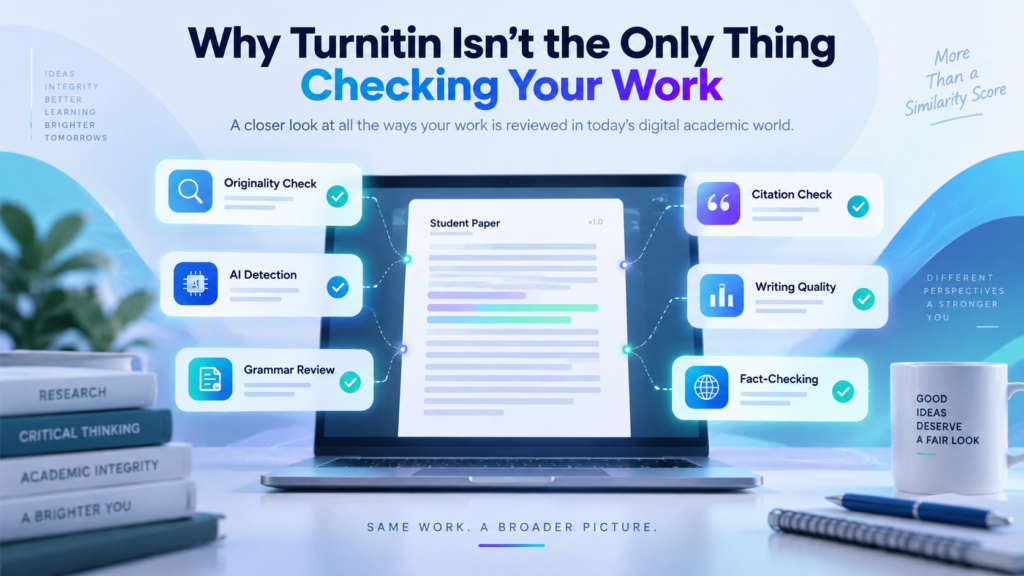
Understanding this landscape is not just an academic exercise as it directly affects how you should think about your own writing process, what kinds of evidence might protect you if your work is ever questioned, and why the assumptions many students hold about what “passing” actually means may already be out of date.
What Turnitin Actually Does
Turnitin’s core function has always been comparing submitted text against a massive database of academic papers, web pages, and previously submitted student work to generate a similarity or originality report. According to Turnitin’s own product page, the tool analyzes writing in segments and scores each portion to evaluate whether text was likely written by a human or generated by AI, with these scores combined into an overall prediction.
It is worth being precise about what this actually means. As one university guide to interpreting the Turnitin Originality Report explains, a high similarity percentage does not automatically indicate plagiarism as it simply flags text that closely matches something already in Turnitin’s database, and it is up to a human instructor to interpret whether that overlap reflects a genuine integrity problem or simply proper citation of a commonly referenced source.
Turnitin’s Real Limitations
It Cannot Catch Everything That Counts as Misconduct
Traditional similarity matching, by its very nature, only catches text that closely resembles something already in Turnitin’s database. Entirely original but dishonestly obtained work content written by someone else on your behalf, commonly known as contract cheating will often show a low similarity score precisely because it has never been submitted or published anywhere before. A guide from American Public University notes that Turnitin has been expanding into testing whether submitted work was created using artificial intelligence, precisely because traditional similarity matching alone leaves this entire category of misconduct largely invisible.
AI Writing Detection Has Its Own Serious Accuracy Problems
Even Turnitin’s newer AI writing detection component, alongside other dedicated AI detection tools, faces well-documented accuracy challenges. A recent Inside Higher Ed report notes that a growing number of institutions including several major research universities, have moved to prohibit faculty from relying on AI detection programs as the sole evidence in academic misconduct cases, specifically because these tools have proven unreliable enough to produce meaningful numbers of false accusations against students who did not actually use AI.
This is a significant shift. Many universities that once treated a flagged AI score as strong evidence are now treating it as, at best, a prompt for further human investigation rather than proof on its own. One university’s official guidance on academic integrity in the age of AI explicitly states that AI detectors are not licensed by the institution and are considered highly unreliable, warning that these tools often generate false positives and can be fooled by simple rewording.
The Growing Landscape of AI Detection Tools
Turnitin is far from the only system in this space. A wide range of AI detection tools now exists, each with different strengths, accuracy rates, and intended audiences, and understanding this broader landscape matters whether you are a student trying to understand what might be checking your work, or simply trying to understand how seriously to take any single tool’s result.
QuillBot’s AI Detector
QuillBot, originally known primarily as a paraphrasing tool, now offers its own built-in AI content detector alongside its other writing tools. According to a detailed comparison from Tekpon, QuillBot’s detector scores around 75 to 80 percent accuracy on long-form English text — meaningfully lower than some competing AI detection tools which the same analysis attributes partly to QuillBot’s focus on accessibility and integration with its broader writing suite rather than pure detection performance.
ZeroGPT
ZeroGPT is another widely used, free AI text detector that analyzes submitted text at the document, paragraph, and sentence level to estimate the likelihood of AI generation. It is worth noting that user reviews of ZeroGPT are notably mixed, with a number of reported cases of entirely human-written text including, in some widely shared examples, historical documents predating AI entirely being flagged as AI-generated. This inconsistency is a useful illustration of a broader pattern among AI detection tools: results can vary dramatically depending on which specific tool is used, making any single score an unreliable basis for a serious accusation on its own.
GPTZero
GPTZero, created by a Princeton University student shortly after ChatGPT’s public release, has grown into one of the more established names among AI detection tools specifically built with education in mind. According to a detailed review from Originality.ai, GPTZero was among the more consistent performers in independent academic studies comparing multiple AI detectors, though even strong performers in these studies are far from perfectly reliable.
Copyleaks
Copyleaks combines plagiarism detection with AI content analysis, and is used by a number of educational institutions directly integrated into learning management systems. Copyleaks claims accuracy rates above 99 percent in its own internal testing, though as with any vendor-reported accuracy figure, independent, third-party verification is generally more informative than a company’s own marketing claims.
Why This Matters Beyond Just Knowing the Names
The existence of this crowded field of competing AI detection tools, each with different methodologies and accuracy rates, has an important practical implication: even if your work passes one detector cleanly, that result says relatively little about how it would perform against a different tool, or against the specific combination of tools and human judgment your own institution actually uses. Treating any single detector’s score as a definitive verdict in either direction misunderstands how inconsistent this entire category of technology currently is.
Why Many Universities Are Pulling Back From AI Detectors Entirely
Perhaps counterintuitively, one of the most important recent developments is not the addition of more detection technology, but institutions actively stepping back from relying on it. The Inside Higher Ed reporting referenced earlier notes that Yale, Vanderbilt, Johns Hopkins, and Indiana University are among a growing list of institutions that have restricted or discouraged faculty reliance on AI-detection programs as standalone evidence of misconduct.
This shift reflects a genuine tension in higher education. Faculty know that AI-assisted cheating has become dramatically easier and more common, but the tools built to catch it have not kept pace in reliability, creating real risk of falsely accusing honest students while, in some cases, missing genuinely dishonest work entirely. This is precisely why understanding the full landscape of AI detection tools as well, as how universities are actually using or deliberately not using those matters more than simply assuming Turnitin’s score is the final word.
What Replaces Pure Detection: Process, Not Just Product
As confidence in purely automated AI detection tools has declined, many institutions and individual instructors have shifted toward verifying the writing process itself, rather than relying exclusively on analyzing the finished product.
Version History and Document Metadata
Google Docs and similar platforms retain detailed version history showing exactly how a document was built over time, when edits were made, how long the writing process took, and whether text was typed incrementally or pasted in large blocks all at once. A piece published in Faculty Focus describes how some instructors now ask students to demonstrate this kind of recursive drafting process as evidence of authentic authorship, specifically because this kind of documentation is far harder to fake convincingly than simply submitting a clean final draft.
Redesigned Assessments
Rather than relying entirely on detection after the fact, many instructors are redesigning assignments to make dishonest completion more difficult in the first place — requiring in-class writing components, oral defenses of written work, or assignments tied closely to specific, personalized class discussions that would be difficult for outside sources or AI tools to replicate convincingly.
Direct Conversations and Oral Defense
Increasingly, when an instructor suspects an issue, the follow-up is not simply citing a detector’s score but engaging the student directly asking questions about their argument, sources, or specific choices in the text that a genuine author would be able to answer easily and a non-author likely could not. This kind of verification, while more time-consuming than running a report, sidesteps the reliability problems inherent in any single automated tool.
Explicit Institutional Policies
Universities increasingly publish clear, explicit policies on AI use rather than relying purely on detection technology to enforce vague, unstated expectations. Clearly communicated rules such as what is permitted, what must be disclosed, and what constitutes a violation give both students and faculty a much clearer framework than an ambiguous reliance on a similarity or AI score alone.
What This Means for You as a Student
A Clean Turnitin Score Is Not a Guarantee
Given everything above, it should be clear that a low Turnitin similarity score, or a favourable result from any single one of the other AI detection tools covered here, does not constitute a comprehensive guarantee that your work will pass every form of scrutiny it might face. Genuine, honestly produced original work remains the only reliable strategy, rather than optimizing specifically to defeat any particular detection system.
Document Your Own Process
Given the growing emphasis on process-based verification, it is worth developing habits that naturally leave a legitimate paper trail: drafting in a platform that retains version history, keeping research notes as you go, and saving earlier drafts rather than only the final polished version. Not only does this protect you if your work is ever questioned, it is also simply good academic practice independent of any integrity concern.
Understand That Standards Are Still Evolving
Because so many institutions are actively revising their policies and practices around AI detection tools in real time, it is worth reading your specific institution’s current guidelines rather than assuming older, more familiar assumptions about how Turnitin works still apply uniformly. What counted as acceptable practice even a year or two ago may already be outdated given how quickly this landscape continues to shift.
Disclose AI Assistance When Required
Many institutions now have explicit disclosure requirements around any use of AI tools, even for legitimate purposes like brainstorming or grammar checking. Understanding and following your specific institution’s disclosure policy is a far more reliable path than hoping any assistance you used will simply go undetected by whichever combination of AI detection tools your instructor happens to apply.
How Institutions Combine Multiple Signals Rather Than One Score
Given the reliability problems outlined above, many institutions have moved toward a layered approach that treats no single tool as decisive on its own. Rather than relying on one number from one system, a more robust process typically weighs several signals together: a similarity report, an AI detection score, the instructor’s own familiarity with a student’s usual writing voice, and any direct conversation with the student about their work.
This layered approach exists precisely because each individual signal, taken alone, carries real limitations. A similarity report can miss contract cheating entirely. An AI detection score can misfire on entirely human-written text, particularly work by non-native English speakers, whose writing patterns have been shown in multiple studies to trigger disproportionately high false-positive rates across several major AI detection tools. Combining signals, and involving human judgment throughout rather than automating the decision entirely, has become the more defensible standard as institutions grow more aware of these individual weaknesses.
The University of Arkansas’s academic integrity policy illustrates this layered approach in practice, explicitly defining contract cheating as its own distinct category of misconduct and separate from traditional plagiarism and outlining a formal review process that goes well beyond simply citing a single automated report as evidence. Institutions building policies this way are effectively acknowledging that AI detection tools and similarity checkers are useful starting points for investigation, not self-contained verdicts.
The Bigger Picture: Why This Landscape Keeps Shifting
It is worth understanding why the rules and tools around academic integrity feel like they are constantly changing, rather than settling into a stable, predictable system. Generative AI capabilities have evolved extremely quickly, and detection technology has consistently lagged a step behind, trying to catch up to whatever the newest generation of AI writing tools can produce. Every time detection accuracy improves against one generation of AI-generated text, newer models emerge that are harder to distinguish from human writing, restarting the cycle.
This ongoing arms race is exactly why relying on any single, static understanding of how AI detection tools work is a risky long-term strategy, whether you are a student trying to understand what might be evaluating your work or an instructor trying to build a fair, defensible process. The specific tools in wide use today, and how much institutional trust they carry, will very likely look meaningfully different within another year or two, just as the landscape has already shifted substantially since early, more optimistic assumptions about detection technology’s reliability.
For students specifically, this uncertainty reinforces a simple, durable conclusion: rather than trying to calibrate your work against the quirks of any particular detector, the more resilient strategy is producing genuinely original work, understanding your specific institution’s current policies, and being prepared to demonstrate your own authorship through the writing process itself rather than through any single tool’s approval.
A Practical Checklist for Academic Integrity
- Have you read your specific institution’s current AI use and disclosure policy, rather than relying on general assumptions?
- Are you retaining genuine drafts and version history as you write, rather than only your final submission?
- Have you properly cited and quoted sources, rather than assuming a low similarity score alone proves proper attribution?
- If you used any AI assistance, have you disclosed it according to your institution’s specific requirements?
- Are you prepared to discuss your own argument, sources, and choices directly if asked, rather than relying solely on the written document to speak for itself?
Frequently Asked Questions
If my work passes Turnitin, am I safe from any accusation of academic misconduct? Not necessarily. A low similarity score addresses one specific category of concern — text matching existing sources but does not address contract cheating, undisclosed AI use, or other forms of misconduct that other AI detection tools or process-based verification methods are specifically designed to catch.
Are AI detectors accurate enough to be trusted on their own? Current evidence suggests no, at least not as standalone proof. Multiple studies and a growing number of institutional policies treat AI detector results as one input among several rather than definitive evidence, given well-documented false positive rates across the major tools.
Why would a university stop using AI detectors if cheating is a real problem? Because the risk of falsely accusing honest students of misconduct, based on an unreliable tool, is a serious concern in its own right. Many institutions have concluded that process-based verification and redesigned assessments are more reliable than relying heavily on imperfect detection technology.
Should I worry about false positives if I write honestly? It is a legitimate concern given documented accuracy issues across various AI detection tools, which is exactly why maintaining genuine drafts, notes, and version history is valuable as it gives you concrete evidence to point to if your honestly produced work is ever incorrectly flagged.
Final Thoughts
Turnitin remains an important part of how academic work is evaluated, but it has never been the entire picture, and that picture has only grown more complex as AI detection tools have proliferated and institutions have grappled with their real-world limitations. The safest, most durable approach is not chasing a clean score from any particular tool, but producing genuinely original work, documenting your process honestly, and understanding your specific institution’s current, evolving policies rather than relying on outdated assumptions about how any single system operates.
The broader lesson here extends well beyond any one tool or policy: academic integrity has always been less about satisfying a specific technical check and more about the underlying honesty of the work itself. Detection technology will keep evolving, institutional policies will keep shifting in response, and the specific names and tools discussed in this article may well look different in a few years. What will not change is that genuine, well-documented, honestly produced work holds up regardless of which combination of systems happens to be reviewing it at any given moment. Building habits around transparency and authentic process, rather than optimizing narrowly for whichever detector happens to be in use, is the strategy most likely to serve you well no matter how this landscape continues to develop.
Navigating citation rules, originality standards, and an increasingly complex landscape of detection tools can feel overwhelming on top of the actual work of researching and writing.
Need structured support with critical academic reading?
KM Academic Success offers professional guidance and editing support for students working on theses, dissertations, and research papers, helping ensure your work is genuinely well-crafted, properly cited, and submission-ready with confidence. Learn more at KM Academic Success.