
BLOGS
Transition Sentences: The Small Fix That Makes Your Thesis Read Better
A strong thesis is not only about research quality but also about how ideas connect. Transition sentences help readers move smoothly from one concept to another. Good academic writing requires clarity, structure, and logical flow.
Academic writing requires clarity, organization, and coherence. Transition sentences act as bridges that connect paragraphs and sections, making the overall thesis appear more structured and professional. They help explain relationships between ideas, introduce new arguments, and maintain consistency throughout the research. By using effective transitions, students can improve readability and ensure that their thesis communicates information in a clear and meaningful way. Small improvements in sentence connections can create a major difference in the overall quality and impact of academic writing.
What Are Transition Sentences?
Transition sentences are connecting statements placed between ideas, paragraphs, or sections. They explain relationships between arguments and improve readability. Learn more about improving academic writing through KM Academic Success.
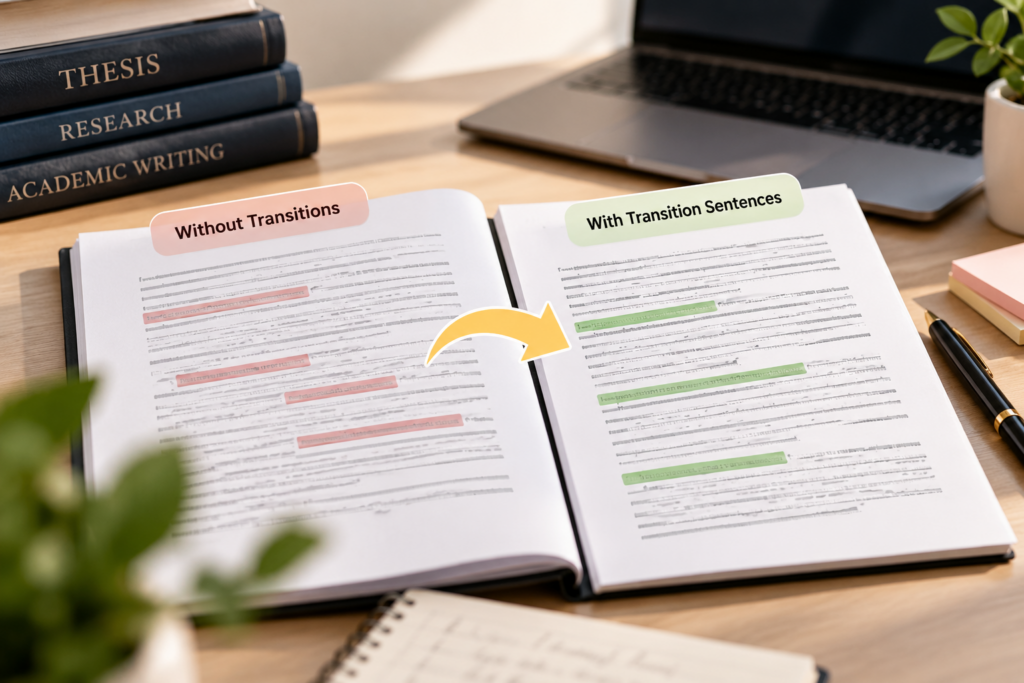
Transition sentences are statements that connect one idea, paragraph, or section to another in academic writing. They help readers understand how different arguments relate to each other and why the writer is moving from one point to another. Unlike simple transition words, transition sentences provide complete explanations that create logical connections between concepts. They are commonly used in research papers, dissertations, and theses to maintain a smooth flow of information.
In thesis writing, transition sentences prevent the document from feeling like a collection of separate paragraphs. They guide readers through the research journey by showing connections between previous discussions and upcoming ideas. For example, after explaining existing research, a transition sentence can introduce research gaps or explain why a particular methodology was selected. Students who want to improve their academic writing skills can explore resources from KM Academic Success for guidance on creating clearer and more effective academic documents.
Why Transition Sentences Matter in Thesis Writing
A thesis contains complex arguments, evidence, and analysis. Effective transitions guide readers through the research journey and make the overall document more coherent. Transition sentences are essential in thesis writing because they improve the organization and readability of complex research. A thesis usually contains several chapters and sections, including literature review, methodology, results, and discussion. Each part presents different information, but all sections must connect with the main research objective. Effective transitions help readers understand how each chapter contributes to the overall argument and prevent confusion when moving between different topics.
Strong transitions also make academic writing appear more professional and convincing. When ideas are connected properly, readers can easily follow the researcher’s reasoning and understand the importance of each argument. Poor transitions may cause valuable research findings to lose their impact because the relationship between ideas is unclear. By developing strong transition skills, students can improve the structure of their thesis and create a better experience for supervisors, reviewers, and academic audiences.
Types of Transition Sentences
Transition sentences can be divided into different categories depending on the relationship they create between ideas. Some transitions are used to add new information, while others show contrast, explain cause and effect, compare concepts, introduce examples, or summarize arguments. Understanding these different types helps writers choose the most suitable transition for each situation. The correct use of transitions allows academic writing to become more organized and easier to follow.
Type of Transition | Purpose | Examples |
Addition | Adds new information or supporting points | Furthermore, additionally, moreover |
Contrast | Shows differences between ideas | However, although, in contrast |
Cause and Effect | Explains relationships between events | Therefore, consequently, as a result |
Comparison | Shows similarities | Similarly, likewise |
Example | Introduces supporting evidence | For example, for instance |
Sequence | Shows order of ideas | First, next, finally |
Conclusion | Summarizes information | Overall, in conclusion |
Using different types of transition sentences helps maintain variety and prevents repetitive writing. Researchers should select transitions based on the relationship between ideas rather than simply adding common transition words. A well-balanced use of transitions creates stronger connections between arguments and improves the overall quality of a thesis. When used correctly, transitions become powerful tools for presenting research in a clear and professional manner. Transitions may show addition, contrast, cause and effect, comparison, examples, sequence, and conclusions.
Examples of Transition Improvements
Weak Transition | Improved Transition | Purpose |
Another point is… | Building on this argument, the next section examines… | Connects ideas |
However… | Despite these findings, previous research suggests… | Shows contrast |
In conclusion… | Considering the evidence discussed above… | Introduces summary |
Improve Academic Writing Skills with Trusted Resources
Improving academic writing requires more than simply presenting information. Students need to understand how to organize ideas, develop strong arguments, and create smooth connections between different sections of their research. Clear writing structure helps readers follow complex concepts and improves the overall quality of a thesis. Reliable learning resources can guide students in developing better writing habits and understanding academic standards. The Purdue Online Writing Lab provides valuable guidance on academic writing, research documentation, formatting, and effective communication techniques that help students produce stronger scholarly work.
Strengthen Thesis Structure and Research Presentation
A successful thesis depends on how effectively research ideas are presented and connected. Many students face challenges with organizing chapters, improving paragraph flow, and maintaining a professional academic tone. Developing strong writing strategies allows researchers to communicate their findings more clearly and confidently. Resources such as Scribbr provide helpful materials related to thesis writing, proofreading, citations, and research documentation, helping students improve both the accuracy and presentation of their academic projects.
Enhance Clarity and Writing Accuracy
Academic writing requires precision, clarity, and attention to language. Even strong research can lose its impact when sentences are unclear or ideas are poorly expressed. Students can improve their writing by focusing on sentence structure, grammar, readability, and logical organization. Tools and educational resources from Grammarly Education help learners improve communication skills, refine their writing style, and create clearer academic documents suitable for research and professional environments.
Develop Better Research Writing Techniques
Creating a well-organized thesis requires effective planning and strong writing techniques. Researchers need to connect ideas logically, support arguments with evidence, and maintain consistency throughout different chapters. Academic writing centers provide valuable support by teaching students how to structure essays, research papers, and dissertations. The University of North Carolina Writing Center offers useful academic writing resources that help students improve organization, argument development, and overall writing effectiveness.
Improve Scholarly Writing and Critical Thinking
A high-quality thesis requires strong analytical skills and the ability to communicate complex ideas clearly. Students must learn how to build arguments, evaluate information, and present research findings in a professional manner. Academic writing guidance can help learners improve critical thinking and develop stronger scholarly communication skills. The Harvard College Writing Center provides resources focused on academic writing, analysis, and improving the overall quality of research-based documents.
Use Effective Academic Language and Transitions
Using appropriate academic language helps researchers express ideas more professionally and clearly. Many students struggle with finding suitable phrases when writing literature reviews, discussions, and research analyses. Learning how to use formal academic expressions can improve the flow and readability of a thesis. The Manchester Academic Phrasebank provides examples of academic phrases and language structures that assist researchers in writing more effective scholarly content.
Learn Through Professional Writing Courses
Academic writing skills improve through continuous learning, practice, and feedback. Students can benefit from structured courses that teach research methods, communication skills, and professional writing techniques. Online education platforms provide flexible opportunities for learners to develop important academic abilities. Platforms like Coursera offer courses that help students improve writing, research, and professional development skills.
Connect With Global Research Communities
Research becomes stronger when students engage with academic communities and explore published studies in their fields. Connecting with researchers allows learners to discover new ideas, understand current developments, and improve their research approach. Online research networks provide opportunities for knowledge sharing and academic collaboration. ResearchGate allows researchers and students to access publications, share knowledge, and connect with professionals from different academic backgrounds.
Improve Research Skills and Publication Knowledge
Writing a thesis is only one part of the academic research journey. Researchers also need to understand publishing standards, ethical practices, and effective research communication. Learning about professional research processes helps students prepare stronger academic work. The Elsevier Researcher Academy provides educational resources that support researchers in developing skills related to publishing, research methods, and academic success.
Promotional Paragraph: KM Academic Success
Students working on academic projects, essays, and thesis writing often need structured guidance to improve clarity, organization, and research presentation. KM Academic Success provides academic support resources designed to help learners strengthen their writing skills and produce better-structured work. Visit https://kmacademicsuccess.com/ for more information.
FAQs
- What are transition sentences in academic writing?
Transition sentences are statements that connect one idea, paragraph, or section to another in academic writing. They help readers understand the relationship between different arguments and maintain a logical flow throughout a thesis. Effective transitions act as bridges between concepts, making complex research easier to follow. They improve readability, strengthen organization, and allow writers to present their ideas in a more professional and structured manner.
- Why are transition sentences important in a thesis?
Transition sentences are important because they create smooth connections between different parts of a thesis. Without proper transitions, research can appear disconnected and difficult to understand. They help readers follow the writer’s reasoning, understand relationships between arguments, and recognize changes in topics. A well-written thesis uses transitions to improve coherence, strengthen academic presentation, and provide a better reading experience for supervisors, reviewers, and academic audiences.
- Where should transition sentences be used in a thesis?
Transition sentences can be used throughout a thesis, including between paragraphs, sections, and chapters. They are especially useful when introducing new ideas, comparing previous research, explaining methodology changes, or moving from results to discussion. Using transitions strategically helps maintain consistency and guides readers through the research process. They should appear naturally wherever a connection between ideas is needed rather than being added unnecessarily.
- How do transition sentences improve thesis readability?
Transition sentences improve thesis readability by creating a clear pathway between different ideas. They prevent sudden changes in topics and help readers understand how each point connects to the overall argument. When readers can easily follow the structure of a thesis, they are more likely to understand and appreciate the research. Strong transitions make academic writing appear more organized, professional, and easier to evaluate.
- What is the difference between transition words and transition sentences?
Transition words are individual words or short phrases such as “however,” “therefore,” and “furthermore,” while transition sentences are complete statements that explain the connection between ideas. Transition words provide simple links, but transition sentences offer deeper explanations and improve logical flow. In thesis writing, both are useful, but complete transition sentences are often more effective because they clearly show relationships between arguments.
- Can poor transition sentences affect thesis quality?
Yes, poor transition sentences can negatively affect thesis quality because they make the writing appear fragmented and difficult to follow. Even strong research can lose impact if ideas are not connected properly. Weak transitions may confuse readers and reduce the overall professionalism of the document. Developing effective transitions helps researchers present their findings clearly and create a more convincing academic argument.
- How can students write better transition sentences?
Students can write better transition sentences by first understanding the relationship between two connected ideas. They should identify whether they are adding information, showing contrast, explaining cause and effect, or presenting a conclusion. A useful transition should briefly summarize the previous idea and introduce the next point. Regular practice, reviewing academic papers, and receiving feedback can help students improve transition-writing skills.
- Are transition sentences necessary in every paragraph?
Not every paragraph requires a separate transition sentence, but most academic paragraphs benefit from some form of connection. When ideas change or a new argument begins, transitions help readers understand the movement of information. Some paragraphs naturally connect without additional explanation. However, in longer academic documents like theses and dissertations, carefully placed transitions usually improve clarity and overall structure.
- How do transition sentences help in literature reviews?
Transition sentences are especially valuable in literature reviews because researchers often discuss multiple studies, theories, and viewpoints. They help connect previous research findings and show relationships between different sources. Effective transitions allow writers to compare studies, identify gaps, and develop a logical argument. A well-structured literature review uses transitions to move smoothly from one research theme to another.
- How many transition sentences should a thesis contain?
There is no fixed number of transition sentences required in a thesis because the amount depends on the topic, length, and structure of the research. Instead of focusing on quantity, writers should focus on quality and placement. Transitions should be included whenever they improve understanding and create stronger connections between ideas, sections, or arguments.
- What are common mistakes when writing transition sentences?
Common mistakes include using the same transition words repeatedly, adding transitions that do not match the relationship between ideas, and creating sentences that feel forced. Some writers use transitions only at the beginning of paragraphs without explaining connections. Effective transitions should be meaningful, specific, and directly related to the argument. Avoiding these mistakes helps create smoother and more professional academic writing.
- Can transition sentences improve thesis grades?
Strong transition sentences can contribute to better thesis evaluation because they improve organization, clarity, and readability. Academic reviewers often consider structure and logical development when assessing research work. While transitions alone do not determine grades, they support the overall quality of writing by making arguments easier to understand. A well-connected thesis demonstrates stronger communication skills and academic professionalism.
- Should transition sentences be formal in academic writing?
Yes, transition sentences in academic writing should maintain a formal and professional tone. They should clearly explain relationships between ideas without using casual expressions or unnecessary words. Academic transitions should support the argument and maintain consistency with the research style. Formal language helps create credibility and ensures that the thesis meets academic writing expectations.
- Can professional academic services help improve thesis writing?
Professional academic support services can help students improve different aspects of thesis writing, including organization, clarity, structure, and language development. Guidance from experienced professionals can help researchers identify weaknesses and strengthen their academic presentation. Services such as KM Academic Success provide resources and support for students looking to improve their academic writing skills and develop stronger research documents.
- How do transition sentences make a thesis more professional?
Transition sentences make a thesis more professional by improving the connection between arguments and creating a smoother reading experience. They demonstrate that the writer understands how different ideas relate to each other. A thesis with effective transitions appears more organized, thoughtful, and carefully developed. By using appropriate transitions, researchers can communicate complex information clearly and present their work with greater academic confidence.
Conclusion
Transition sentences are a small but powerful improvement that can transform thesis readability. By connecting ideas effectively, researchers can create clearer and more professional academic documents.
Need help reviewing a thesis before submission?
KMAS can support source verification, literature-review organisation, citation and reference consistency, paraphrasing checks, thesis formatting, and academic-integrity focused revision. The purpose is to help researchers make their own work clearer, properly attributed, and submission-ready – not to hide copied text or manipulate similarity software.