
BLOGS
What Happens If Your Thesis Flagged for Plagiarism?
A practical guide to similarity reports, academic-misconduct investigations, possible outcomes, and what to do next
A plagiarism flag is not automatically a plagiarism verdict. |
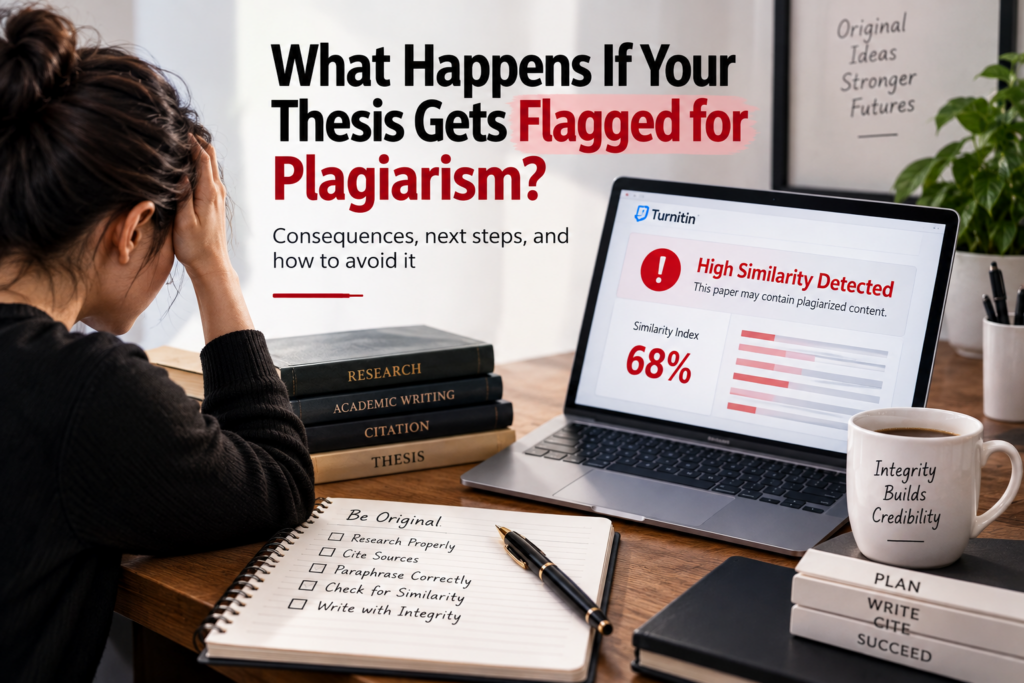
Few thesis-related emails create more panic than a message saying your work has been “flagged for plagiarism.” Students often assume that a coloured percentage on a similarity report means their degree is already in danger. That is not how a responsible academic-integrity process works.
Turnitin states clearly that its Similarity Report does not determine whether plagiarism has occurred. It identifies text in a submission that matches material in its databases. Correctly quoted passages, references, standard methodological language, previously submitted drafts, and legitimate source-based writing can all create matches. A high similarity score can require careful review, but a score by itself is not proof of misconduct. A low score is not proof of innocence either.
What happens next depends on where you study, whether the document was a draft or final submission, how much material is affected, the type of source use involved, whether attribution is present, whether the problem appears accidental or deliberate, and whether there is a history of earlier misconduct. Universities use different procedures and penalties, so no blog can tell you the exact outcome of an individual case.
What can be explained is the usual logic of the process. A flag is reviewed. The matching passages are examined. The student may be asked for an explanation or invited to an interview or panel. The institution decides whether the issue is acceptable similarity, poor academic practice, or academic misconduct. If misconduct is upheld, consequences can range from corrections or mark penalties to failure, exclusion, and – in very serious cases under some regulations – revocation of an already awarded degree.
This guide explains each stage so you can respond calmly, preserve evidence, understand the difference between similarity and plagiarism, and avoid making the situation worse.
First: Similarity Is Not the Same as Plagiarism
Turnitin defines the similarity score as the proportion of a submission that matches sources in the databases selected for comparison. Its current guidance explicitly says that Turnitin does not itself decide whether a paper is plagiarised; academic judgement is required.
This distinction matters because theses naturally contain source-based material. Literature reviews cite many studies. Methodology chapters may use standard terminology. Reference lists repeat published titles. Direct quotations may be completely legitimate when they are marked and cited correctly. A thesis can therefore contain substantial matched text without every match being problematic.
The reverse is also true. A low overall score can hide a serious issue if a small but intellectually important section – for example the central analysis or original argument – is copied without acknowledgement. Institutions normally examine the character of the match, not only the percentage.
There is no universal “safe percentage.” |
Why a Thesis Might Be Flagged Even When You Did Not Intend to Plagiarise
- Direct quotations are matched. Properly quoted and cited text can still appear in a similarity report because the software is reporting textual similarity, not judging whether the quotation is academically acceptable.
- The bibliography is included. Reference entries contain published titles, journal names, DOIs, and other text that naturally appears elsewhere.
- You submitted an earlier draft. A final thesis can match a previous version stored in a repository, creating substantial self-matches that require interpretation.
- Standard wording appears in your methods. Technical phrases, instrument names, legal wording, or standard procedure descriptions can match other documents.
- Your paraphrase is too close to the source. Changing a few words while keeping the source sentence structure can still be academically problematic even when a citation is present.
- A citation is present but the quotation is not marked. The source may be acknowledged, yet copied wording still needs quotation marks or block-quote formatting where required.
- You reused your own earlier assessed or published text. Many institutions treat unacknowledged reuse of your own prior assessed work as self-plagiarism or duplicate submission.
- Another person submitted your work. Collusion, file sharing, theft, or an earlier submission by another person can create unexpected matches.
What Usually Happens After a Thesis Is Flagged
The precise procedure varies, but universities generally do not move straight from a similarity score to a final punishment. Oxford, for example, states that suspected plagiarism in a research thesis is referred for investigation and the student may be called for interview. If no breach is found, disciplinary action stops, although thesis changes may still be required. If a potential breach remains, the matter can be referred into the formal disciplinary process.
UCL likewise provides a formal academic-misconduct procedure that can include investigatory panels and, for research students, an investigatory viva. The central principle is that the allegation is considered through an institutional process rather than being decided by a software score.
- The report is reviewed
An examiner, supervisor, academic-integrity officer, or designated staff member checks the matched passages and the matched sources. They may exclude bibliographies, quotations, or irrelevant small matches when interpreting the report. - The nature of the overlap is assessed
The reviewer asks whether the text was quoted, cited, paraphrased, self-reused, copied, fabricated, or obtained from another person or service. They also consider whether the matched material affects core analysis or only peripheral text. - You may be contacted
You may receive a request for explanation, an invitation to an interview, an investigatory viva, or notice of a formal academic-misconduct process. Read the notice carefully and note deadlines. - Evidence is considered
Drafts, notes, reference-manager records, tracked changes, data files, version histories, supervisor feedback, and the original sources can help establish how the thesis was produced. - A finding is made
The institution may conclude there is no misconduct, identify poor academic practice requiring correction, or uphold an allegation of academic misconduct. - An academic or disciplinary outcome follows
Possible outcomes depend on the rules, severity, extent, intent, research level, and prior record. Serious thesis cases can have much greater consequences than a minor citation error in ordinary coursework.
What Reviewers Are Actually Looking At
A sensible investigation asks more than “What percentage is shown?” The reviewer may examine how much material is involved, where it appears, what kind of intellectual work it represents, whether citations are present, whether wording is copied exactly, whether the student attempted to disguise copying, and whether the issue could have changed the academic credit awarded.
Manchester’s doctoral guidance, for example, says penalty decisions can take account of the extent and proportion of plagiarism and apparent intent. Cambridge guidance distinguishes small amounts in less central sections of a research thesis from significant unacknowledged material used to produce core analysis or arguments. This illustrates why location and intellectual importance matter.
- How much text or material is affected.
- Whether the matched material is central to the thesis argument, findings, analysis, or contribution.
- Whether the source was cited at all.
- Whether copied wording was properly marked as a quotation.
- Whether paraphrasing genuinely re-expressed the source or stayed too close to its structure.
- Whether the work reused the student’s own previous assessment or publication without appropriate acknowledgement.
- Whether data, references, quotations, or evidence were fabricated.
- Whether text manipulation or another technique was used to conceal similarity.
- Whether a third party or AI system produced work in a way prohibited by the institution.
- Whether there are previous confirmed academic-integrity offences.
Possible Outcomes: From No Action to Serious Penalties
There is no single penalty schedule across universities. The same-looking similarity score can lead to very different outcomes because the underlying conduct may be completely different. Official university policies demonstrate the range.
Oxford says plagiarism penalties can range from deduction of marks to expulsion and that intentional or reckless plagiarism in assessed work can lead to severe outcomes, including failure of the degree. UCL lists penalties including mark reductions, zero marks, failure of modules, suspension, exclusion, and for research students, failure of an upgrade or final examination with possible resubmission where regulations permit. Manchester’s doctoral guidance also describes outcomes ranging from degree downgrading or a lesser qualification to disciplinary measures.
Possible finding/outcome | What it can mean | When it may arise | Important caution |
No misconduct found | The matches are accepted as legitimate or insufficient to establish a breach | Correct quotation/citation, irrelevant matches, repository self-match, or allegation not proved | You may still be asked to improve the thesis academically |
Corrections / academic guidance | Referencing or writing may need correction | Poor academic practice or problems resolved without a major misconduct finding under local rules | Not every institution uses this category in the same way |
Mark or grade penalty | A thesis/component result may be reduced or capped | Confirmed misconduct of a level addressed through assessment penalties | Exact penalty is regulation-specific |
Resubmission / re-examination | The thesis may need correction and another examination opportunity | Some research-degree procedures allow a further attempt | A resubmission may be capped or restricted |
Failing the thesis or degree | The work or programme may be failed | Serious or extensive misconduct | Consequences can affect progression and award |
Suspension / exclusion | Student status can be suspended or terminated | Serious, repeated, or aggravated misconduct | Only formal university procedures can impose this |
Award revocation after graduation | An already awarded degree can be cancelled under some regulations | Serious misconduct discovered and proved after award | This is exceptional but explicitly possible at some universities |
A serious thesis case can remain relevant after graduation. |
What You Should Do Immediately If You Receive a Plagiarism Notice
- Read the notice, not just the word “plagiarism.” Identify whether you have received an informal query, a similarity report, an allegation, an invitation to a meeting, or a formal misconduct charge. Those are different stages.
- Download and preserve the exact submitted version of your thesis, the similarity report if available, and every document the university has provided.
- Do not alter or delete drafts, notes, reference-manager libraries, tracked-change files, data files, cloud version history, emails, or supervisor feedback. These can be important evidence of how the thesis developed.
- Review each significant match against the original source. Mark whether it is a quotation, paraphrase, bibliography match, previous draft, your own earlier work, standard terminology, or material that should have been acknowledged differently.
- Read the academic-integrity regulations that actually apply to your programme and research degree. Do not rely on TikTok, forums, or generic “Turnitin percentage” advice.
- Contact the appropriate source of support: supervisor, graduate school, programme office, student union/advice service, academic adviser, or another person identified in the procedure. Ask what representation or accompaniment is permitted.
- Prepare a factual explanation. Distinguish mistakes you genuinely made from matches that are legitimate. Do not invent a story, blame software, or deny an obvious match.
- Meet every deadline. If you need more time to access evidence or obtain advice, use the formal route for requesting it rather than ignoring the notice.
What Not to Do After You Are Flagged
- Do not panic-rewrite the submitted file. Once a final thesis is under review, changing your local copy does not change what was submitted and may destroy useful evidence of version history.
- Do not run the text through “humanisers” or synonym tools. Trying to disguise copied text can create a second integrity issue and does not fix missing attribution.
- Do not delete drafts or browsing history. Evidence showing your genuine research process may help you.
- Do not focus only on lowering the percentage. The task is to correct source use and explain authorship, not to game a score.
- Do not fabricate missing references. A false citation or invented source can turn a referencing problem into a more serious integrity problem.
- Do not contact the matched author aggressively. If another student submission appears as the source, let the institution investigate access and chronology.
- Do not submit a long emotional defence without evidence. A concise chronology supported by drafts, notes, citations, and sources is usually more useful than speculation.
How to Prepare for an Investigatory Meeting or Viva
An investigatory meeting is not the time to memorise excuses. It is the time to show that you understand your thesis and can explain how specific passages were produced. Bring or have access to relevant drafts, notes, original articles, reference-manager records, data and analysis files, and any supervisor comments that help establish chronology.
You may be asked about wording, sources, your research process, or why particular citations appear or do not appear. If you made a referencing mistake, say so accurately. If a match is legitimate, explain why and point to the evidence. If you do not know the answer to a question, it is better to say that than to improvise.
- ☐ Create a table of the main flagged passages and the source matched to each one.
- ☐ For every passage, identify whether it was quoted, paraphrased, reused from your own earlier work, or written independently.
- ☐ Locate the original source and the exact page or section you used.
- ☐ Find drafts showing when the passage entered the thesis and how it changed.
- ☐ Bring reference-manager metadata, reading notes, coding files, lab notebooks, data logs, or other discipline-relevant records.
- ☐ Read the definition of plagiarism and self-plagiarism in your own institution’s regulations.
- ☐ Prepare a short chronology of your thesis-writing process rather than a general defence of your character.
- ☐ Ask in advance whether you may be accompanied or represented and what documents the panel will consider.
What If the Similarity Comes From Your Own Previous Work?
Students are sometimes surprised to learn that reusing their own writing can still cause an integrity problem. The issue is not that you are stealing from yourself. The issue is whether previously assessed or published material is being presented as new work without appropriate acknowledgement or permission.
Policies differ. Edinburgh’s postgraduate-research regulations include one’s own previously assessed original work within its plagiarism definition. Manchester likewise warns doctoral researchers to explain and justify contributions where publications are incorporated into a thesis.
A thesis by publication, integrated article, transfer report, conference paper, or earlier dissertation may legitimately overlap with later work under specific rules. The safest approach is to follow your programme’s policy, cite or declare reused material where required, and explain co-author contributions clearly.
What If the Flag Comes From an Earlier Draft Stored in Turnitin?
This is one of the clearest examples of why a percentage is not a verdict. Turnitin notes that resubmitting a paper that was previously stored in a repository can create very high self-matching. In some configurations, a final version may even appear to match an earlier version extensively.
If the earlier submission is genuinely your own draft, preserve the submission receipt or other evidence showing chronology. The examiner or administrator can interpret the match in context. Do not assume that a 100% self-match automatically means the thesis will be treated as plagiarism.
What If You Cited the Source but Paraphrased Too Closely?
A citation does not automatically make copied wording acceptable. If you reproduce an author’s sentence or distinctive phrasing, quotation conventions normally apply. If you paraphrase, the wording and sentence structure should genuinely become your own while the underlying idea remains cited.
Close paraphrasing often happens when students write while looking directly at the source sentence. A safer method is to read the passage, close or move away from it, write the idea from your understanding, then compare your wording with the source and add the citation. Keep technical terms that cannot reasonably be changed, but do not mechanically substitute synonyms.
What If the Problem Is in the Literature Review?
Literature reviews naturally contain many citations, but they still require original synthesis. A review can be heavily referenced and still be plagiarism-free; conversely, it can contain citations and still be problematic if paragraphs closely reproduce source wording or structure.
Examiners usually expect the researcher to compare studies, identify patterns and contradictions, evaluate methods, and connect the evidence to the thesis question. Copying one paper at a time and changing a few words produces a patchwork review rather than synthesis.
If your literature review is flagged before final submission, focus on source use and synthesis. Rewrite from your reading notes, group literature by theme or argument, preserve citations, and quote only where the original wording is genuinely necessary.
What If the Problem Is in the Methods Section?
Methods chapters sometimes produce legitimate similarity because research procedures, instrument names, standard equations, or established protocols are described using conventional terminology. That does not mean you can copy another thesis wholesale.
Where a method is adopted or adapted from a source, cite the source. Where wording must remain exact – for example a licensed instrument item, legal definition, or protocol text – use the form of quotation or reproduction required by your field and permissions. Where the procedure is your own application of a standard method, describe what you actually did in your own words.
What If the Problem Is in the Results or Discussion?
Similarity in results, analysis, or discussion can attract greater concern because these sections are expected to demonstrate the student’s own research contribution and intellectual work. Cambridge’s examiner guidance, for example, treats significant unacknowledged material used to produce analysis or core arguments in a research thesis more seriously than small amounts in peripheral sections.
If your findings or interpretation closely reproduce another work, the institution may ask whether the research contribution is genuinely yours. This is also why copied tables, figures, code, statistical interpretations, or translated passages need proper attribution and, where applicable, permission.
Does Intent Matter?
Intent can matter to seriousness and penalty, but lack of intention does not always eliminate a breach. Oxford explicitly warns that inadvertent plagiarism can still attract a penalty. Manchester’s doctoral guidance similarly describes academic malpractice as potentially intentional or otherwise and says cases are treated seriously.
This can feel harsh, but research degrees require candidates to understand source attribution. Institutions may distinguish poor practice from deliberate deception, yet the student remains responsible for accurate citation and original presentation. The most useful response is therefore not simply “I did not mean to plagiarise,” but a documented explanation of what happened and why.
Can a Thesis Be Flagged After You Graduate?
Yes. Some universities explicitly allow academic-misconduct allegations to be investigated after an award has been made. UCL’s current academic-misconduct procedure applies penalties to alumni and states that an award may be revoked in serious cases. Edinburgh’s postgraduate-research regulations similarly state that plagiarism discovered before or after graduation can be investigated and that the university has power, in proved cases of substantial and significant plagiarism or fraud, to reduce the classification of or revoke a degree.
That does not mean old theses are routinely re-examined or that every later-discovered citation problem leads to revocation. It means the authority exists under some institutional rules when serious misconduct is subsequently proved.
How Appeals Work
If misconduct is found, the university should tell you what review or appeal route is available. Appeals are normally limited to defined grounds such as procedural irregularity, new evidence that could not reasonably have been provided earlier, bias, or another ground stated in the regulations. They are not simply a second opportunity to disagree with academic judgement.
Read the decision letter carefully. Note the deadline, permitted grounds, required form, and evidence rules. If your student union or graduate school offers independent casework advice, use it. An appeal is strongest when it identifies a specific procedural or evidential issue and supports it with documents.
How to Reduce Plagiarism Risk Before Final Thesis Submission
- ☐ Keep a complete reference-management library and attach page numbers or notes while reading.
- ☐ Mark copied words clearly in your research notes so they cannot later be mistaken for your own prose.
- ☐ Draft synthesis from notes rather than writing with the source sentence open beside you.
- ☐ Use quotation marks or block quotations wherever exact wording is reproduced.
- ☐ Cite paraphrases as well as direct quotations.
- ☐ Check figures, tables, images, code, scales, and datasets for attribution and permission requirements.
- ☐ Declare and cite reuse of your own prior assessed or published work according to your programme rules.
- ☐ Explain co-author or collaborator contributions when required, especially in thesis-by-publication formats.
- ☐ Use any permitted similarity-checking draft process as a learning tool, not as a score-reduction game.
- ☐ Investigate every substantial match before submission and correct the source use, not merely the wording.
- ☐ Keep dated drafts, analysis files, lab notebooks, code repositories, and supervisor feedback.
- ☐ Ask your supervisor or graduate school when you are unsure about an unusual source, translation, AI-assisted writing, or reuse situation.
A Better Way to Read a Similarity Report
Match type | First question | Potentially acceptable? | Action |
Bibliography/reference | Is this simply citation metadata? | Often | Interpret/exclude only according to institutional settings |
Direct quotation | Is it marked and cited correctly? | Yes, if permitted and proportionate | Check quotation and citation format |
Paraphrase | Is the wording and structure genuinely independent? | Yes, if properly paraphrased and cited | Rewrite if too close; keep the citation |
Own previous draft | Can you prove authorship and chronology? | Often | Provide draft/submission evidence |
Own previous assessed/published work | Does policy permit reuse and is it declared? | Sometimes | Follow self-plagiarism/reuse rules |
Large uncited block | Is there a legitimate explanation? | Usually high concern | Locate source and seek advice immediately |
Core analysis/argument match | Who produced the intellectual work? | Potentially serious | Prepare detailed authorship and source evidence |
A 24-Hour Response Checklist
- ☐ Save the allegation/notice and note the response deadline.
- ☐ Save the submitted thesis and similarity report exactly as they were received.
- ☐ Read the institution’s current plagiarism and research-degree misconduct procedure.
- ☐ List the ten most significant matches rather than staring at the overall percentage.
- ☐ Open every matched source and compare it with your thesis.
- ☐ Collect drafts, notes, references, version history, data, code, and supervisor feedback.
- ☐ Write a one-page factual chronology of how the thesis was prepared.
- ☐ Contact the university support route identified in the notice.
- ☐ Do not delete, alter, fabricate, or conceal evidence.
- ☐ Prepare to explain the thesis itself – not merely the similarity score.
Useful Backlinks & Official Guidance
- Turnitin – Turnitin and Plagiarism – Explains why similarity is not the same as plagiarism and why context and academic judgement are required.
- Turnitin – Understanding the Similarity Score – Explains what the percentage measures, why legitimate text can match, and why a score alone is not a misconduct finding.
- Oxford University – Plagiarism – Official guidance on plagiarism, investigation, student interviews, and the range of possible penalties.
- Oxford University – Research Examinations – Thesis-specific guidance on what happens when plagiarism is suspected in a research thesis.
- UCL – Student Academic Misconduct Procedure – Detailed current procedure covering investigations, panels, penalties, research students, and alumni.
- University of Manchester – Plagiarism and Referencing for Doctoral Researchers – Doctoral-thesis guidance on plagiarism, referencing, author contribution, seriousness, and possible penalties.
- University of Edinburgh – Postgraduate Research Assessment Regulations – Research-degree regulations explaining plagiarism and investigation even when discovered after graduation.
- KMAS – Academic support for literature-review structure, referencing, source checking, research writing, formatting, and responsible revision workflows.
Final Thought: Treat the Flag as a Review Process, Not a Percentage Panic
If your thesis is flagged, the most important thing to remember is that the similarity number is not the final academic judgement. What matters is the underlying source use.
Some matches are completely legitimate. Some reflect correctable referencing or paraphrasing problems. Others can reveal serious plagiarism, unauthorised collaboration, fabricated material, contract cheating, or unacknowledged reuse. The university’s job is to distinguish among those possibilities using its regulations and evidence.
Your job is to respond with the same discipline you should bring to research: preserve records, verify sources, read the applicable procedure, meet deadlines, explain the writing process accurately, and take responsibility for genuine mistakes without accepting allegations that the evidence does not support.
A thesis is judged on authorship, evidence, attribution, and intellectual contribution – not on whether you managed to push a similarity score below a number you found online.
Need help reviewing a thesis before submission?
KMAS can support source verification, literature-review organisation, citation and reference consistency, paraphrasing checks, thesis formatting, and academic-integrity focused revision. The purpose is to help researchers make their own work clearer, properly attributed, and submission-ready – not to hide copied text or manipulate similarity software.