
BLOGS
Self-Plagiarism: Can You Plagiarize Your Own Work?
A practical guide for students, dissertation writers, researchers, and academic authors
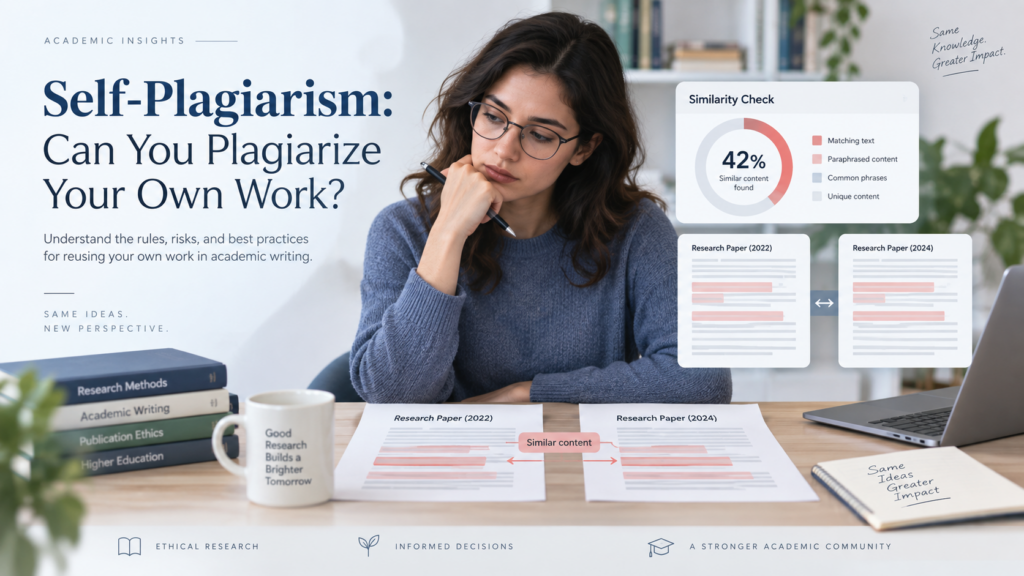
Introduction: Why “Plagiarizing Yourself” Is Not as Contradictory as It Sounds
Plagiarism is usually understood as presenting another person’s words, ideas, data, or creative work as your own. That definition makes the phrase “self-plagiarism” sound contradictory: if you created the material, how can you steal it from yourself? In academic work, however, the central issue is not simply ownership of words. It is transparency about whether submitted or published material is genuinely new. The U.S. Office of Research Integrity explains self-plagiarism as the reuse of previously disseminated content in a new product without making its earlier use clear to the reader. The Committee on Publication Ethics (COPE) often uses the more precise term “text recycling” when discussing repeated textual material in scholarly publications.
This distinction matters for students, researchers, dissertation writers, and authors. A paragraph written by you last year is still your writing, but if you submit it in a new assessment as though it were newly produced, you may breach your institution’s academic-integrity rules. Likewise, an author who publishes substantially the same findings in several papers without disclosure can create a misleading impression of novelty and productivity. Self-plagiarism is therefore better understood as a problem of undisclosed reuse, originality, assessment fairness, and publication transparency rather than the literal theft of another person’s intellectual property.
The rules are also contextual. Not every repeated phrase or reuse of your own material is automatically misconduct. Acceptability depends on how much is reused, where it appears, whether the original source is acknowledged, what the assignment or journal permits, and whether copyright or publication agreements apply. This guide explains those distinctions and shows how to reuse your own previous work responsibly.
What Is Self-Plagiarism?
Self-plagiarism occurs when a writer reuses their own previously submitted, shared, or published material and presents that material as new without adequate disclosure or attribution. Universities may also describe the practice as double-dipping, duplicate submission, or text recycling. The University of British Columbia, for example, defines self-plagiarism as reusing one’s own academic work as new work without citing the previous use, and its academic-integrity rules address reuse without appropriate referencing and prior approval.
The concept can apply to more than exact sentences. It may involve resubmitting an entire assignment, copying substantial passages from an earlier essay, lightly paraphrasing one’s previous writing without acknowledgement, reusing previously disseminated data as if newly collected, republishing substantially overlapping findings, or dividing one research project into multiple papers in ways that obscure their relationship. In scholarly publishing, some of these practices have more specific labels, including duplicate or redundant publication and “salami slicing.”
It is important to separate self-plagiarism from ordinary plagiarism. Traditional plagiarism involves insufficient attribution of someone else’s work. Self-plagiarism involves insufficient transparency about your own prior work. The ethical mechanisms are different, but both can mislead the audience about the origin or novelty of the material. That is why many institutions and publishers regulate both.
Why Is Self-Plagiarism Considered a Problem?
The strongest reason is that academic assessment and scholarly publication usually carry an expectation of originality. When a lecturer assigns a new essay, the marks normally reflect the work completed for that assessment. Submitting an old paper again can create the impression that new work has been undertaken when it has not. This can undermine fairness when other students are completing the assignment from the beginning.
In research publishing, the concern extends to the scholarly record. Readers, editors, reviewers, and other researchers need to understand what findings are new and how a new paper relates to earlier publications. Repeated publication of the same data can distort perceptions of the amount of evidence available, particularly if later reviewers mistakenly treat overlapping papers as independent studies. ORI emphasizes transparency about prior dissemination, while COPE distinguishes ordinary text recycling from the more serious issue of redundant or duplicate publication.
There can also be copyright complications. An author may have written an article but transferred certain publication rights to a publisher. Reproducing large portions elsewhere may therefore involve not only publication ethics but also contractual or copyright considerations. For this reason, “I wrote it, so I can reuse it anywhere” is not a safe assumption once material has been formally published.
Common Forms of Self-Plagiarism in Student Work
For students, the clearest example is submitting the same paper for two courses without permission. A student might change the title, rewrite the introduction, or replace a few sentences while retaining most of an earlier assignment. Even though the student authored both versions, the second submission may violate assessment rules because it presents previously assessed work as a new response.
A subtler version occurs when students copy several paragraphs from an earlier essay into a dissertation, capstone project, or new assignment without acknowledging that the material appeared before. Rewriting the sentences superficially does not necessarily solve the transparency problem if the ideas, organization, or substantive material are being recycled in a context that expects original work.
Previous work can sometimes be legitimately developed into a later project. A proposal may evolve into a dissertation, or an undergraduate project may inspire postgraduate research. The correct approach is to check institutional rules and discuss the overlap with the supervisor or instructor. Permission, acknowledgement, citation, and meaningful development can make the difference between legitimate continuity and inappropriate duplicate submission.
Self-Plagiarism in Theses and Dissertations
Long research projects create special questions because academic work often develops cumulatively. A doctoral candidate may publish an article from thesis research, or a dissertation chapter may build on material presented earlier at a conference. These relationships are not inherently unethical. What matters is whether the relationship among the documents is transparent and complies with institutional and publisher policies.
Researchers should disclose previous dissemination and cite or acknowledge relevant earlier versions where required. A thesis-by-publication model naturally contains published material, but universities usually have specific rules about authorship, co-authored work, permissions, and declarations. A conventional thesis may also legitimately develop ideas from an earlier proposal, but the student should not assume that every piece of previously assessed text can simply be copied.
Before reusing substantial content, check the graduate-school handbook, thesis regulations, supervisor guidance, and any publisher agreement connected to the earlier work. If a thesis chapter has already produced a journal article, make that relationship clear rather than allowing readers to assume that the texts are completely independent contributions.
Text Recycling in Journal Articles
COPE uses “text recycling” to describe situations in which portions of an author’s own text appear in more than one publication, usually without attribution. Its guidance stresses that significance depends on factors such as the amount of repeated text, the location of the overlap, whether the source is acknowledged, the type of article, and potential copyright issues. This means that editors do not necessarily treat every repeated phrase identically.
Context matters because some sections of scientific papers naturally contain standardized language. A highly technical methods description may be difficult to rewrite repeatedly without reducing precision. By contrast, results and conclusions are expected to communicate what is distinctive about the current study. COPE guidance indicates that duplicated previously published data in a results section is generally much more problematic and may amount to redundant publication rather than simple text recycling.
Authors should therefore avoid chasing an arbitrary similarity percentage. A similarity report identifies matching text; it does not by itself decide whether the overlap is ethical. Editors and institutions consider the source, extent, location, disclosure, purpose, and policy. The safest approach is transparent citation and disclosure combined with compliance with the target journal’s instructions.
Duplicate Publication and Redundant Publication
Duplicate publication occurs when substantially the same research is published more than once without appropriate disclosure. This is more serious than merely repeating a few sentences. Duplicate publication can make one study look like multiple independent contributions and can create problems for evidence synthesis, citation metrics, and perceptions of researcher productivity.
There are legitimate situations in which related publications emerge from the same project. A large study may support distinct research questions, or a conference abstract may later develop into a full journal article. However, the relationship should be disclosed, the new paper should make a meaningful contribution, and journal policies should be followed. Authors should cite related papers and tell editors about potentially overlapping manuscripts when required.
Transparency is the key principle. Readers should be able to understand what data have appeared before, what analysis is new, and how the new publication extends previous work. Concealing substantial overlap is what turns ordinary scholarly development into an integrity concern.
What Is “Salami Slicing”?
Salami slicing describes dividing a dataset or research project into multiple small publications when the work would be more appropriately communicated as a coherent whole. Not every publication from the same dataset is salami slicing. Large datasets can legitimately answer several distinct questions. The problem arises when papers are fragmented mainly to increase publication counts, contain substantial overlap, or fail to disclose their common origin.
If several papers use the same participants or dataset, each manuscript should make its specific research question clear and cite related outputs where appropriate. Editors should be able to see why each paper contributes something sufficiently distinct. Researchers should also consider whether repeated analyses could lead readers or systematic reviewers to mistake overlapping samples for independent evidence.
A practical test is to ask whether the second paper adds a genuinely different question, analysis, interpretation, population segment, or theoretical contribution. If the answer is mainly that the title and a few variables have changed, the publication strategy may need reconsideration.
Can You Reuse Your Own Ideas?
Ideas require a more nuanced answer than copied text. Research naturally builds on earlier thinking, and scholars are expected to develop lines of inquiry over time. You do not need to pretend that every new paper emerged without intellectual history. However, when a particular concept, model, argument, dataset, or interpretation has already been disseminated, citing the earlier work helps readers understand the development of the research.
Self-citation is therefore not something to avoid automatically. Appropriate self-citation can provide essential provenance and show how the current study extends prior scholarship. Problems arise when self-citation is excessive and irrelevant, or when relevant earlier work is omitted to make a new paper appear more novel than it is.
The objective is not to cite yourself for every ordinary thought you have ever expressed. It is to disclose prior work when knowing about that work would materially affect a reader’s judgment of originality, evidence, or contribution.
Can You Reuse Your Own Data?
Previously collected data can be reused legitimately, but their provenance should be unmistakable. Secondary analysis of an existing dataset is a normal research practice. Researchers may revisit data with a new theoretical question, use a different analytical technique, combine datasets, or conduct follow-up analyses. The ethical issue is not reuse itself; it is presenting old data in a way that suggests they were newly collected or independent when they were not.
ORI’s ethical-writing guidance stresses that authors should clearly indicate prior dissemination of data and related material. If the same sample appears in multiple publications, authors should cite connected studies and explain the overlap where relevant. Ethical approval, participant consent, data-use agreements, and confidentiality requirements may also determine whether a new analysis is permitted.
For students, the same principle applies to coursework. Reusing a dataset from a previous assignment may be allowed in some modules and prohibited in others. Ask the instructor before assuming that a new analysis automatically makes the submission acceptable.
Is Reusing a Methods Section Always Self-Plagiarism?
Methods sections are one of the most debated areas of text recycling. Researchers repeating a protocol may need to describe identical equipment, procedures, statistical routines, or laboratory conditions. Constantly inventing new wording for a fixed technical process can be awkward and may even reduce clarity.
COPE guidance recognizes that the location and nature of repeated text matter, and contemporary editorial guidance often treats limited reuse in methods differently from duplicated results or conclusions. Nevertheless, authors should not assume unlimited verbatim copying is acceptable. The original method can often be cited and summarized, with modifications described clearly. Journal-specific rules remain decisive.
If substantial wording must be repeated for accuracy, check the target journal’s text-recycling and copyright policies. When in doubt, disclose the overlap to the editor. Transparency is safer than trying to hide textual similarity through superficial synonym changes.
Does Paraphrasing Your Old Work Solve the Problem?
Not necessarily. Self-plagiarism is not solely a word-matching issue. If you paraphrase an old assignment but still present substantially the same previously assessed contribution as new work, the academic-integrity concern may remain. Similarly, rewriting previously published findings without citing the earlier paper can obscure the relationship between publications even if plagiarism-detection software finds little textual similarity.
Paraphrasing is useful when you need to integrate prior material into a genuinely new argument, but attribution may still be necessary. The important question is whether a reasonable reader should know that the idea, analysis, data, or substantive content appeared before.
This is why students should not treat similarity scores as the definition of plagiarism. A low percentage does not guarantee academic integrity, and a high percentage does not automatically prove misconduct. References, standard terminology, correctly quoted passages, and legitimate methodological overlap can all generate matches. Human judgment and institutional policy determine significance.
How Similarity-Detection Software Fits Into the Picture
Universities and publishers commonly use similarity-detection tools to identify textual overlap. These systems can help reviewers locate matching passages, but they do not independently determine intent, attribution, permission, or academic misconduct. A report should be interpreted rather than treated as a simple pass-or-fail score.
Self-overlap may be detected when previous student submissions are stored in institutional databases or when earlier work is publicly accessible. Published articles, repositories, theses, websites, and other indexed documents can also generate matches. Trying to “beat” a checker by mechanically replacing words is poor practice because it focuses on the software rather than the integrity of the writing.
A better pre-submission review asks where each match comes from, whether the source should be cited, whether quotation is appropriate, whether reused material is permitted, and whether the new submission contains enough original contribution for its purpose.
How to Reuse Your Previous Work Responsibly
The safest process begins before copying any material. First, identify the status of the earlier work: was it submitted for assessment, published, posted in a repository, presented at a conference, or kept as a private draft? Second, check the rules governing the new submission. A university, instructor, journal, funder, or publisher may have a specific policy on prior work and duplicate submission.
Next, disclose relevant overlap. Cite your earlier work when it is a source for the new document and when citation is appropriate to the context. If an assessment rule requires permission, obtain that permission before submission. For a journal article, inform the editor about related manuscripts, preprints, conference papers, or prior publications when the journal requests such information. If copyright has been transferred, verify whether the intended reuse is permitted.
Finally, make sure the new work has a genuine new purpose. Reusing a small amount of properly acknowledged background is very different from repackaging an old paper. New analysis, new evidence, a new research question, substantially expanded interpretation, or a clearly different scholarly contribution should be visible.
When Self-Citation Is Appropriate
Self-citation is appropriate when your previous publication is genuinely relevant to the current argument, methodology, dataset, or research history. Cite it as you would cite another relevant scholarly source, using the citation style required by your institution or journal. Do not omit your own relevant work merely because citing yourself feels awkward.
For unpublished coursework, citation conventions can vary. A previous essay may not be publicly retrievable, and an instructor may prefer acknowledgement or explicit permission rather than a conventional reference entry. This is one reason students should consult their course policy or lecturer before reusing assessed work.
For theses, dissertations, conference materials, preprints, and published articles, established citation styles usually provide ways to identify the source. The goal is provenance: readers should understand where the prior material came from and how the current work relates to it.
Copyright and Self-Plagiarism Are Different Issues
Academic integrity and copyright overlap but are not identical. Self-plagiarism is primarily about transparency, originality, and scholarly expectations. Copyright concerns legal rights to reproduce or adapt material. You can therefore have an academic-integrity problem without copyright infringement, or a copyright problem involving words that you originally wrote.
Publication contracts are particularly important. Depending on the license and agreement, authors may retain extensive reuse rights or may need permission for particular forms of reproduction. Open-access licenses can also establish specific attribution conditions. Do not infer your rights from authorship alone.
When repurposing published material, check the publisher’s author-rights information, the license attached to the article, and your institution’s guidance. If the situation is unclear, ask the publisher or an institutional copyright specialist before reproducing substantial text, figures, or tables.
Consequences of Self-Plagiarism
Consequences depend on context and policy. In coursework, unauthorized duplicate submission may lead to a reduced grade, a requirement to redo the work, an academic-integrity investigation, or other disciplinary action. Universities define and handle these cases differently, so students should rely on their own institution’s regulations rather than assuming that practices are universal.
In publishing, editors may ask authors to rewrite overlapping text, provide disclosure, cite the original source, or explain the relationship between manuscripts. More serious duplicate or redundant publication can lead to rejection, correction, retraction, or institutional follow-up. COPE provides editors with guidance for assessing text recycling and overlapping publications.
It is also worth noting a legal-policy nuance: the U.S. Office of Research Integrity states that self-plagiarism is not classified as research misconduct under the federal definition in 42 CFR Part 93. That does not mean it is acceptable. It can still violate journal, university, professional, or publication-ethics requirements.
What to Do If You Have Already Reused Your Work
If you realize before submission that you have reused previous material without sufficient acknowledgement, correct it before submitting. Identify the overlap, review the relevant policy, add citations or disclosure where appropriate, and rewrite only where rewriting is genuinely required. If the reuse involves an entire previous assignment or substantial assessed material, ask the instructor rather than assuming citation alone will make resubmission permissible.
If the work has already been submitted, contact the instructor, supervisor, editor, or appropriate academic-integrity office promptly. Explain what was reused and where it originally appeared. Early, transparent communication is usually more constructive than waiting for a similarity report or editorial check to reveal the overlap.
For published work, do not attempt to conceal the relationship by silently changing online versions or citations. Follow the journal’s correction process and seek editorial guidance. The appropriate remedy depends on the extent and significance of the duplication.
Promotional: Build Stronger Academic Integrity Habits With KM Academic Success
Questions about self-plagiarism often arise because students are uncertain about citation, paraphrasing, dissertation development, or how earlier coursework can legitimately inform a new project. KM Academic Success provides academic guidance intended to help students understand research writing, referencing, structure, editing, and academic-integrity expectations while keeping responsibility for original work with the student. Support can be particularly useful when you need to distinguish acceptable development of previous research from duplicate submission, identify where citations are needed, or review whether a dissertation chapter communicates its sources transparently.
The most useful academic support does not simply aim to lower a similarity percentage. It helps you understand why text has matched, whether attribution is required, how to paraphrase responsibly, and how to build a genuinely new argument from previous learning. Students and researchers can visit KM Academic Success for research guidance, academic writing support, and referencing assistance. Always combine external guidance with the specific academic-integrity policy of your own university or publisher because local rules ultimately govern your submission.
Final Takeaway: Yes, You Can Plagiarize Your Own Work in the Academic Sense
So, can you plagiarize yourself? Under many academic and publishing policies, yes: reusing your own previously submitted or disseminated work without appropriate acknowledgement, disclosure, or permission can be treated as self-plagiarism. The phrase is imperfect because the issue is not literally stealing from yourself. The central concern is presenting old work as though it were new.
At the same time, responsible reuse is a normal part of scholarship. Researchers build on previous studies, dissertations lead to articles, conference papers evolve, methods recur, and earlier ideas become more sophisticated. Academic integrity does not require you to erase your intellectual history. It requires you to represent that history transparently.
Before reusing your work, ask four questions: Has this material been submitted, shared, or published before? Would the new reader reasonably expect it to be new? Does the institution or publisher permit the reuse? Have I disclosed and cited the earlier work appropriately? If any answer is uncertain, check the relevant policy or ask the instructor, supervisor, or editor before submission. That small step can prevent a serious integrity problem and, more importantly, keeps the scholarly record clear about what is old, what is new, and how your work has developed.
Useful Backlinks and Further Reading
- KM Academic Success
- Committee on Publication Ethics (COPE) – Text Recycling Guidance
- U.S. Office of Research Integrity – Self-Plagiarism
- ORI – Guidelines at a Glance on Avoiding Plagiarism
- University of British Columbia – Academic Integrity Glossary
- University of Missouri – Self-Plagiarism Guidance
- University of Melbourne – Publication and Authorship Guidelines
- University of Glasgow – Defining Self-Plagiarism
Editorial Note
This article provides general educational guidance, not a substitute for your institution’s academic-integrity regulations, assessment instructions, journal policies, copyright advice, or supervisor guidance. Rules on prior-work reuse vary by context, so always check the policy that governs your specific submission.
Need structured support with critical academic reading?
KM Academic Success offers professional guidance and editing support for students working on theses, dissertations, and research papers, helping ensure your work is genuinely well-crafted, properly cited, and submission-ready with confidence. Learn more at KM Academic Success.