
BLOGS
How to Critically Evaluate a Journal Article (Not Just Summarize It)
A practical guide to moving from “what the authors said” to a reasoned judgement about quality, credibility, relevance, and contribution
The one question that changes your reading |
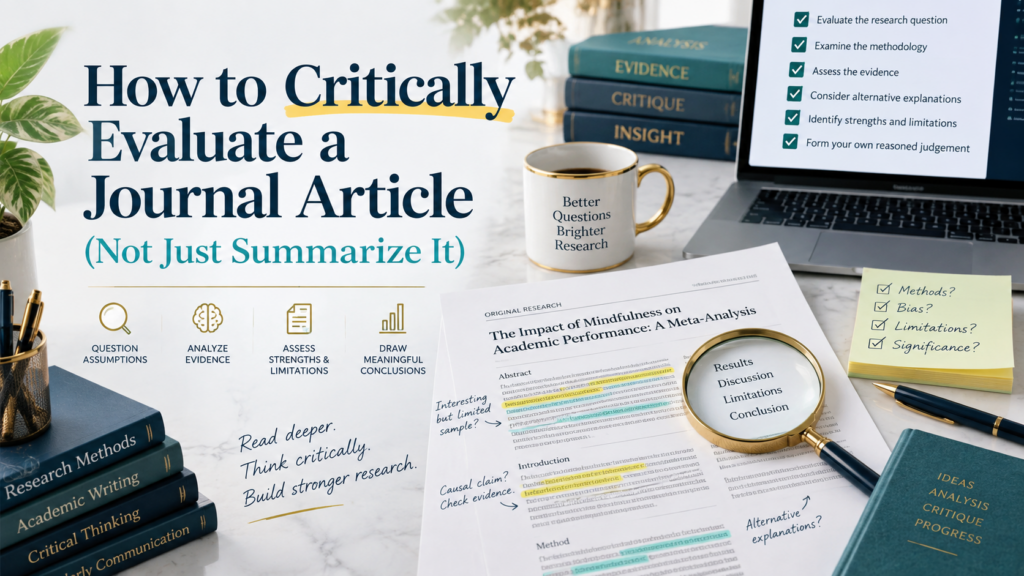
You finish reading a journal article and your notes look impressive: the aim, sample, method, major results, conclusion, and a few quotations. Then your lecturer writes the same comment in the margin: “Too descriptive. Where is the critical analysis?”
This is one of the most common problems in academic writing. Students often assume that “critical” means being negative, finding faults, or disagreeing with the authors. It does not. Critical evaluation means making a balanced, evidence-based judgement about how well a study was designed, how trustworthy its findings are, how appropriately the authors interpreted them, and how useful the article is for your particular question.
A strong critique can conclude that a study is valuable. It can also identify limitations without dismissing the entire paper. In fact, the best critical writing often sounds measured rather than dramatic: the sample supports one kind of inference but not another; the method is appropriate for the research question but leaves an important source of bias unresolved; the findings are useful in one context but may not transfer easily to another.
Critical appraisal frameworks help make this judgement systematic. The Critical Appraisal Skills Programme (CASP) provides free checklists for several study designs, while JBI publishes design-specific appraisal tools intended to assess the trustworthiness, relevance, and results of published research. The EQUATOR Network complements these tools by helping readers locate reporting guidelines such as CONSORT, STROBE, PRISMA, and COREQ for different study types. These resources do not replace your judgement; they help you ask better questions.
First: Summary and Critical Evaluation Are Not the Same Thing
A summary tells the reader what the article contains. A critical evaluation tells the reader what the article is worth as evidence. Both are necessary. You cannot evaluate a study you have misunderstood, but stopping at accurate description is not enough for a literature review, critical appraisal assignment, evidence-based practice discussion, or postgraduate research chapter.
The difference becomes clear when you compare the verbs. Summary uses verbs such as states, reports, examines, identifies, finds, and concludes. Critical evaluation adds verbs such as supports, limits, strengthens, weakens, justifies, overlooks, aligns, conflicts, generalises, transfers, and contributes. These verbs force you to discuss the relationship between the authors’ choices and the credibility of their conclusions.
Reading move | Summary asks | Critical evaluation asks | Example |
Purpose | What did the authors investigate? | Is the question clear, important, and answerable? | A clear objective is a strength only if the design can actually answer it. |
Methods | What method did they use? | Was the method appropriate and executed well? | A cross-sectional survey can estimate associations, but not establish temporal causation. |
Results | What did they find? | Are the results precise, credible, and consistent with the data? | A statistically significant result may still have a small or uncertain practical effect. |
Conclusion | What did the authors conclude? | Does the conclusion stay within what the evidence supports? | Language such as “caused” is too strong if the design only demonstrates correlation. |
Relevance | What topic does the article address? | How useful is it for my population, question, or argument? | A rigorous study may still have limited relevance if its setting differs substantially from yours. |
A Six-Part Critical Appraisal Framework
Use this mental model |
1. Start With the Research Question
Before judging statistics, sample size, or limitations, identify exactly what the paper is trying to answer. A well-written title or abstract can make a study sound focused while the actual objective remains vague. Look for the research question, hypothesis, or stated aim and rewrite it in your own words.
Then test its logic. Is the population clear? Is the exposure, intervention, experience, or phenomenon defined? Is the outcome meaningful? Is the question narrow enough for one study to answer? A question can be interesting but still poorly operationalised. For example, “Does social media affect student wellbeing?” is too broad unless the study specifies the type or intensity of use, the wellbeing outcome, the population, and the relevant timeframe.
Also ask whether the paper fills a genuine gap. Authors often claim that “little is known,” but your reading of the literature may show that several similar studies already exist. Critical evaluation compares the stated rationale with the wider evidence base rather than accepting the introduction at face value.
- Is the research question or aim explicit?
- Is the question important enough to justify the study?
- Are the main concepts defined clearly?
- Does the literature review logically lead to the question?
- Is the study trying to answer more than its design can reasonably address?
2. Judge Whether the Study Design Fits the Question
The method should follow from the question. If the authors want to understand lived experience, a qualitative design may be appropriate. If they want to estimate prevalence, a well-designed cross-sectional study can be suitable. If they want to assess the effect of an intervention, a randomised controlled trial may provide stronger causal evidence when randomisation is feasible and ethical. If they want to synthesise existing evidence, a systematic review requires a transparent search, selection, appraisal, and synthesis process.
This is why you should never evaluate every journal article with the same checklist. CASP and JBI provide different appraisal tools for different study designs because the main risks of bias vary by design. A problem that is crucial in a randomised trial may be irrelevant in a qualitative interview study, while issues such as reflexivity and researcher influence matter far more in qualitative work.
Critical writing connects design to inference. Instead of saying, “The study used a cross-sectional survey,” explain what that choice allows and prevents. A cross-sectional design can reveal patterns and associations at a particular point in time, but it usually cannot establish which variable came first. If the authors make causal claims from cross-sectional data, that mismatch is more important than simply naming the design.
3. Examine Sampling, Participants, and Data Collection
Sampling determines who is represented by the evidence. Ask how participants were identified, who was eligible, who actually took part, and who may have been missed. A large sample is not automatically a representative sample. Five thousand volunteers recruited from one online community may still be more biased than a smaller probability sample drawn carefully from the intended population.
Look at recruitment and response. Could people who chose to participate differ systematically from those who did not? Were important groups underrepresented? Were inclusion and exclusion criteria justified? In clinical research, consider attrition and whether dropout differed between groups. In qualitative research, consider whether the sample captured enough diversity and depth for the research question rather than applying quantitative ideas of representativeness mechanically.
Then examine measurement. Were questionnaires validated for the population and language used? Were interview questions suitable and sufficiently open? Were measurements objective or self-reported? Did data collection occur consistently across participants? If the main variables were measured poorly, sophisticated analysis cannot repair the underlying problem.
A useful distinction |
4. Evaluate the Analysis and Results
Once the design and data are understood, ask whether the analysis matches them. In quantitative research, consider whether the statistical tests fit the variable types and study design, whether important assumptions were addressed, whether missing data were handled transparently, and whether confounders were considered when relevant. Do not be intimidated by unfamiliar statistics: begin with the logic of what the analysis is trying to estimate.
A common mistake is treating p < .05 as proof that a finding is important. Statistical significance does not tell you whether the effect is large, precise, useful, or free from bias. Look for effect sizes and confidence intervals where relevant. A very small effect can be statistically significant in a large sample, while a clinically meaningful effect may remain uncertain in a small sample.
In qualitative research, appraisal focuses on a different kind of analytic transparency. Ask how codes or themes were developed, whether the analysis is clearly described, whether interpretations are supported by participant data, and whether the authors considered alternative explanations. Rich quotations can illustrate findings, but quotations alone do not demonstrate a rigorous analytic process.
For systematic reviews, examine whether the search was broad enough, whether eligibility criteria were explicit, whether study quality or risk of bias was assessed, and whether the synthesis method was appropriate. The EQUATOR Network links to PRISMA for systematic review reporting, while appraisal tools such as CASP and JBI can help evaluate methodological credibility.
- Are descriptive and inferential results reported clearly?
- Are effect sizes, confidence intervals, or other measures of uncertainty provided where appropriate?
- Were important confounding variables considered?
- Does the analysis match the design and research question?
- Are missing data, exclusions, or attrition explained?
- For qualitative work, is the path from raw data to interpretation visible enough to follow?
- Are negative, unexpected, or non-significant findings reported rather than ignored?
5. Separate the Findings From the Authors’ Interpretation
The results section tells you what the study observed. The discussion tells you what the authors think those observations mean. Critical readers keep those two levels separate. This is where overclaiming often appears.
Suppose a study finds that students who report heavier social media use also report more anxiety. The observed result is an association. The interpretation might suggest that social media increases anxiety. But alternative explanations remain possible: anxious students may use social media more, a third factor may influence both, or the measurement approach may capture only part of the relationship. A critical paragraph would acknowledge the association while explaining why the design limits causal interpretation.
Also compare the discussion with the stated limitations. Authors sometimes identify a limitation correctly and then write a conclusion that largely ignores it. Your evaluation should judge the final claim against the actual evidence, not against the confidence of the writing style.
6. Decide How Relevant the Article Is to Your Purpose
Quality and relevance are separate judgements. A rigorous study can be only marginally useful for your assignment, thesis, clinical question, or policy context. Conversely, a highly relevant study may have methodological limitations that mean you should use it cautiously rather than exclude it automatically.
Ask whether the population, setting, time period, intervention, exposure, and outcomes match your question. Consider cultural, institutional, technological, and policy differences. A study of first-year undergraduates in one country may not transfer directly to postgraduate students in another. An early study of a rapidly changing technology may remain historically important but have limited current applicability.
Your final evaluation should therefore answer two questions: “Can I trust this result?” and “Can I use this result for the claim I want to make?” Those are not identical.
What to Look For in Each Section of a Journal Article
Article section | Do not stop at… | Critical questions | Possible judgement |
Abstract | Repeating the aim and result | Does the abstract accurately reflect the full paper and acknowledge important limitations? | Useful overview, but insufficient for appraisal. |
Introduction | Listing previous studies | Is the rationale current, balanced, and linked to a clear gap? | Strong rationale, though one competing explanation is underdeveloped. |
Methods | Naming the design | Does the design, sampling, measurement, and procedure support the question? | Appropriate design but convenience recruitment limits representativeness. |
Results | Reporting significant findings | Are results complete, precise, and analysed appropriately? | Association is statistically clear but effect size is modest. |
Discussion | Repeating the authors’ claims | Are alternative explanations considered and claims proportional to the evidence? | Interpretation is plausible but causal wording exceeds the design. |
Conclusion | Quoting the final sentence | What can reasonably be concluded, and what remains uncertain? | Supports a cautious association, not a universal causal claim. |
How to Write a Critical Paragraph Instead of a Descriptive One
A strong critical paragraph usually has five moves:
- Make a judgement or analytical claim.
- Identify the evidence from the article that supports that judgement.
- Explain why the feature strengthens or weakens the evidence.
- Add balance by acknowledging a counterpoint, strength, or limitation.
- Link the judgement to your research question, literature review, or practical decision.
Descriptive version: The study surveyed 420 university students using an online questionnaire. The researchers found a significant relationship between academic stress and sleep quality. They concluded that stress affects student sleep.
Critical version: The study provides useful evidence of an association between academic stress and poorer sleep because it used established measures and recruited a relatively large student sample. However, the cross-sectional design measures stress and sleep at the same time, so the temporal direction remains uncertain. Self-reported sleep may also introduce measurement error. The findings therefore support including academic stress as a relevant correlate of sleep quality, but they do not establish that stress independently causes sleep problems.
The second paragraph still summarises the core result, but every descriptive detail is used to support a judgement. That is what turns information into analysis.
Critical Does Not Mean Negative
Weak critical writing sometimes becomes a hunt for flaws. Every article has limitations, but listing them without judging their importance can be as unhelpful as pure summary. Ask whether a limitation materially changes the conclusion.
For example, a convenience sample may be a serious problem if the authors claim national prevalence, but much less damaging in an exploratory qualitative study seeking to understand a specific group’s experiences. Similarly, a small sample may reduce precision in a quantitative study but may be entirely appropriate for an in-depth qualitative design if the sampling and analysis are well justified.
A balanced critique should identify strengths too. Clear preregistration, validated measures, transparent exclusions, appropriate controls, reflexive qualitative methods, triangulation, robust sensitivity analyses, or replication across settings can strengthen confidence. The goal is not to score the article as “good” or “bad.” It is to determine which conclusions are well supported, which require caution, and why.
Avoid the “limitations paragraph” trap |
Use the Right Appraisal Tool for the Right Study
Formal checklists can improve consistency, especially when you are new to critical appraisal. CASP offers free checklists for randomised controlled trials, systematic reviews, qualitative studies, cohort studies, case-control studies, cross-sectional studies, diagnostic studies, and other designs. JBI also provides design-specific critical appraisal tools and describes them as aids for assessing the trustworthiness, relevance, and results of published papers.
Reporting guidelines answer a related but different question. A guideline such as CONSORT, STROBE, PRISMA, or COREQ helps authors report specific study types transparently. EQUATOR maintains a searchable collection of reporting guidelines. Good reporting makes appraisal easier, but complete reporting does not automatically mean the underlying study is free from bias. Treat reporting quality and methodological quality as connected, not interchangeable.
Study type | Useful appraisal focus | Common reporting guideline to know |
Randomised trial | Randomisation, allocation, blinding, attrition, outcome reporting | CONSORT |
Observational study | Selection, measurement, confounding, temporality | STROBE |
Systematic review | Search, eligibility, risk of bias, synthesis, heterogeneity | PRISMA |
Qualitative study | Sampling, reflexivity, data collection, analysis, credibility | COREQ or SRQR |
Diagnostic study | Patient spectrum, reference standard, verification, accuracy estimates | STARD |
A Practical “Read the Paper Three Times” Method
Pass 1: Map the paper. Read the title, abstract, headings, tables, figures, and conclusion. Identify the study type, question, sample, main outcome, and headline finding. Do not begin detailed critique yet.
Pass 2: Interrogate the methods and results. Read slowly. Mark how participants were recruited, how variables were measured, what analysis was used, what was excluded, and how uncertainty is reported. Use a study-design checklist if useful.
Pass 3: Judge the interpretation and contribution. Read the discussion against your notes, not passively. Ask whether the authors have stayed within the evidence, whether alternative explanations remain, how findings compare with other studies, and what the article genuinely adds.
Red Flags That Deserve Extra Attention
- The research question changes between the abstract, methods, and conclusion.
- The authors make causal claims from a design that mainly supports association.
- Large numbers of participants or observations disappear without clear explanation.
- Measures are created for the study but reliability or validity is not discussed.
- Only significant outcomes receive attention while planned non-significant outcomes vanish.
- Subgroup analyses appear after the fact without a clear rationale.
- Confidence intervals are very wide, but conclusions are written as certain.
- The discussion ignores plausible alternative explanations.
- The sample is narrow, but conclusions are generalised to a much broader population.
- The limitations section names problems but the conclusion behaves as though they do not matter.
- Funding, conflicts of interest, or author roles are unclear where they could be relevant.
- The article is difficult to appraise because essential methodological details are missing.
How to Evaluate Different Types of Evidence Without Using the Wrong Standards
A frequent appraisal mistake is applying quantitative standards to qualitative research or expecting every observational study to behave like a randomised trial. Critical evaluation must be design-sensitive.
For qualitative research, do not criticise a small purposive sample simply because it is small. Instead ask whether the participants were appropriate for the phenomenon, whether the researchers were reflexive about their role, whether the analysis was credible and transparent, and whether the findings are sufficiently grounded in the data.
For quantitative observational research, focus on selection, measurement, confounding, temporality, and precision. For trials, focus more strongly on randomisation, allocation, blinding where possible, attrition, adherence, and outcome reporting. For systematic reviews, the review is only as convincing as its search, eligibility decisions, risk-of-bias assessment, and synthesis.
The principle is simple: judge the study against what its design is intended to do, then judge whether the authors have claimed more than that design can support.
A Simple Critical Evaluation Template You Can Reuse
One-paragraph template |
Common Mistakes Students Make When Critiquing Articles
- Rewriting the abstract. If your paragraph could be produced without reading the methods section, it is probably summary rather than critique.
- Using vague criticism. “The sample was small” is incomplete. Explain how small, relative to what purpose, and what consequence it has for precision or transferability.
- Calling every limitation “bias.” A limitation may reduce precision, relevance, generalisability, or transparency without necessarily creating systematic bias.
- Equating peer review with truth. Publication in a peer-reviewed journal is useful context, but it does not remove the need for appraisal.
- Overvaluing journal prestige. A high-impact journal can publish a study with important limitations, and a specialised journal can publish rigorous evidence highly relevant to your question.
- Ignoring strengths. Balanced evaluation is more persuasive than a list of faults.
- Criticising what the study never intended to do. A qualitative exploration is not weak because it does not estimate prevalence.
- Confusing statistical and practical significance. A low p-value does not automatically mean an effect is meaningful.
- Using generic phrases such as “more research is needed” without specifying what kind of research would resolve the uncertainty.
- Ending without relevance. Your reader needs to know how the appraisal affects your use of the article.
A 10-Minute Critical Appraisal Checklist
- ☐ What exactly was the research question?
- ☐ Was the chosen design suitable for answering it?
- ☐ Who was studied, and how were they selected?
- ☐ How were the main variables, experiences, or outcomes measured?
- ☐ What important source of bias or confounding could remain?
- ☐ Was the analysis appropriate and transparently reported?
- ☐ How large and precise were the findings, not just whether they were “significant”?
- ☐ Do the conclusions match the results and design?
- ☐ What is the strongest feature of the study?
- ☐ What is the most important limitation – and does it change the conclusion?
- ☐ How relevant is the evidence to my population, context, or argument?
- ☐ What should I do with this article: rely on it strongly, use it cautiously, use it for a narrow point, or exclude it from a particular claim?
Useful Backlinks for Critical Appraisal
- CASP – Critical Appraisal Checklists – Free design-specific checklists, including tools for RCTs, systematic reviews, qualitative studies, cohort studies, case-control studies, and cross-sectional studies.
- JBI – Critical Appraisal Tools – Design-specific tools for assessing the trustworthiness, relevance, and results of published research.
- EQUATOR Network – A searchable resource for reporting guidelines such as CONSORT, STROBE, PRISMA, COREQ, and others.
- Purdue OWL – Evaluating Sources – General academic guidance on evaluating information sources and using evidence critically.
Final Thought: Your Job Is to Judge the Evidence, Not Retell the Paper
Critical evaluation begins when description becomes judgement. The question is no longer simply what the authors did, but whether those choices were appropriate, how they shape the findings, what uncertainty remains, and how much weight the evidence deserves.
A useful habit is to force yourself to finish every set of notes with three sentences: “This study is strong because…”, “The most important limitation is…”, and “Therefore I can use this article to support…”. If you cannot complete those sentences, you probably have not finished appraising the paper.
The strongest academic critiques are specific, fair, and proportionate. They do not attack authors. They evaluate evidence. They recognise that methodological strengths and limitations coexist, that different designs answer different questions, and that a study can be useful without being definitive. Once you read journal articles this way, your literature reviews, discussions, evidence tables, and research arguments become much more analytical because you are no longer treating every published conclusion as equally convincing.
Need structured support with critical academic reading?
KMAS can help students organise journal-article appraisal notes, build evidence and literature matrices, check whether critical discussion is genuinely analytical, improve academic structure and flow, and review referencing or document presentation. The aim is to strengthen your own academic judgement and writing process – not replace your authorship – so you can move from “what the paper says” to a clear, evidence-based evaluation of what the paper actually contributes.