
BLOGS
How to Break Down a Thesis Into Weekly, Achievable Goals
Learn how to break down a thesis into weekly, achievable goals with practical planning strategies. Create a manageable thesis schedule, stay organized, track progress, and complete your research one step at a time.
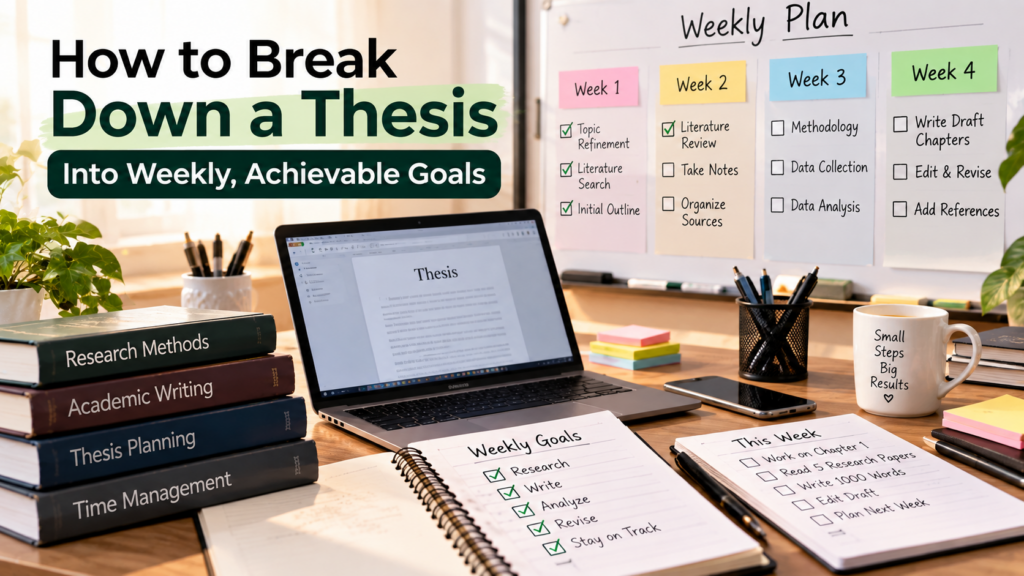
A thesis deadline can be six months away and still feel urgent every day. The problem is rarely that students do not understand that work needs to be done. The problem is that “work on thesis” is too vague to tell you what to do on Tuesday at 10:00 a.m.
Long research projects create a particular planning challenge. The deadline is distant, the work is intellectually demanding, progress is uneven, and some stages depend on people or processes you cannot fully control. Ethics approval can take longer than expected. Participants may be difficult to recruit. Data cleaning can reveal problems. A supervisor may return a chapter with more revisions than anticipated.
That is why weekly planning works better than relying only on a final deadline. Monash University advises students managing complex research tasks to break the main project into smaller tasks, attach specific goals and dates, and track progress over time. The University of Melbourne similarly recommends a long-term planner, weekly calendar, to-do lists, regular writing routines, and realistic goals for graduate research.
The purpose of a weekly system is not to make research perfectly predictable. Research is not perfectly predictable. The purpose is to make the next useful step obvious, give you early warning when the plan is slipping, and prevent a large amount of work from accumulating near submission.
This guide shows how to work backward from your deadline, turn thesis chapters and research stages into weekly outputs, estimate workload realistically, manage supervisor feedback, recover from missed weeks, and build a plan that survives real life rather than looking impressive for three days.
Why “Work on Thesis” Is a Bad Goal
A goal must tell you what completion looks like. “Work on Chapter 2” could mean reading one paper, writing 2,000 words, reorganising headings, checking references, or staring at the document for three hours. Because the finish line is unclear, the task is easy to postpone and difficult to evaluate.
A better weekly goal produces evidence of progress. Examples include: screen 40 abstracts and record decisions; draft 1,200 words for Section 2.3; code Interviews 1-3; create descriptive statistics and check missing values; revise the problem statement using supervisor comments; verify 25 references against original sources.
The goal should be small enough to complete within the week but meaningful enough that completing it moves the thesis forward. This is the level at which a research plan becomes operational.
The Planning Hierarchy: Deadline → Milestones → Weekly Goals → Daily Tasks
Planning level | Example | Typical horizon | Purpose |
Final deadline | Submit complete thesis | Months / years | Defines the non-negotiable endpoint |
Major milestone | Complete literature review draft | 4-12 weeks | Breaks the project into meaningful phases |
Weekly goal | Draft Sections 2.2-2.3, 1,500 usable words | 7 days | Creates measurable progress |
Daily task | Read and synthesise four sources for Section 2.2 | 30 minutes-1 day | Makes the weekly goal executable |
Step 1: Start With the Real Submission Deadline
Write down the official deadline, not the date you hope to finish. Then identify what must happen before submission: supervisor review, final corrections, formatting, reference checking, plagiarism/similarity review where applicable, printing or electronic upload, forms, declarations, and any administrative approval.
Your personal “thesis finished” date should usually be earlier than the official submission date. A buffer protects you against unexpected revisions, formatting problems, missing references, illness, technical failure, or delays in feedback.
The amount of buffer depends on your programme and remaining work, but the principle is universal: do not schedule the last substantive chapter to finish the night before submission.
Work backward, not forward. |
Step 2: List Every Major Thesis Stage
Different theses have different structures, but most research projects contain several categories of work that students often underestimate because they focus only on chapter writing.
Create one master list before assigning weeks. Include research tasks, writing tasks, supervisory tasks, administrative tasks, and revision tasks.
- Research question, aims, objectives, and scope confirmation
- Literature searching and literature matrix
- Literature review synthesis and chapter drafting
- Theoretical or conceptual framework
- Research design and methodology chapter
- Ethics application and amendments, where applicable
- Instrument development, pilot testing, or protocol refinement
- Participant recruitment or data access
- Data collection
- Data cleaning, transcription, coding, or preparation
- Quantitative, qualitative, or mixed-method analysis
- Results/findings chapter
- Discussion chapter
- Introduction and conclusion refinement
- Abstract, acknowledgements, appendices, lists, and front matter
- Reference audit and citation consistency
- Supervisor review cycles
- Final formatting, proofreading, and submission checks
Step 3: Separate “Outcome Goals” From “Activity Goals”
Activity goals describe effort: read for five hours, work on analysis, spend Saturday writing. Outcome goals describe what will exist when the work is done: an annotated matrix containing 12 new papers, a cleaned dataset with missing-value decisions documented, or a 1,500-word draft of the sampling section.
Activities matter, but weekly planning works best when the headline goal is an outcome. The activity then becomes the method used to achieve it.
This prevents false productivity. You can spend eight hours searching literature and still have no clear synthesis. A measurable output makes it easier to evaluate whether the week moved the project forward.
Weak vs Strong Weekly Goals
Weak goal | Stronger weekly goal | Why it is better |
Work on literature review | Add 15 eligible papers to the literature matrix and draft 1,000 words on Theme 1 | Defines evidence of completion |
Do methodology | Draft sampling, recruitment, and data-collection subsections and send them to supervisor Friday | Links writing to a deliverable |
Analyse data | Run descriptive statistics, check missing values, create Table 4.1, and note anomalies | Breaks analysis into specific outputs |
Fix references | Verify every citation in Chapter 3 against the reference list and correct DOI/URL details | Makes the task finite |
Revise chapter | Address supervisor comments 1-12 and rewrite the final two paragraphs of the discussion | Turns feedback into trackable work |
Step 4: Use SMART Goals – But Adapt Them for Research
The University of Melbourne recommends SMART goals for graduate research: Specific, Measurable, Achievable, Relevant, and Time-bound. This framework works well for thesis planning when the goal is written around an output rather than a vague intention.
For research, “achievable” does not mean easy. It means plausible given your available hours, current stage, dependencies, and uncertainty. A goal that requires a participant response you cannot control is not fully achievable; a goal to send 20 recruitment invitations and prepare the follow-up schedule is.
Likewise, “measurable” does not always mean word count. It can mean papers screened, interviews coded, figures completed, reviewer comments resolved, sections reorganised, tables verified, or analysis decisions documented.
Example SMART thesis goal |
Step 5: Estimate Your Real Weekly Capacity
Students often plan from motivation instead of capacity. A full-time student may assume that every weekday contains eight productive thesis hours. A part-time student may assume evenings and weekends are completely available. Both plans usually fail because they ignore classes, work, commuting, family responsibilities, meetings, admin, reading fatigue, and recovery.
ANU’s time-management guidance recommends mapping fixed commitments first, then identifying realistic study blocks. The University of Melbourne similarly encourages graduate researchers to use planners, weekly calendars, and routines while balancing research with other areas of life.
Start with the hours you can realistically protect. Then reduce the number again for deep work. Not every available hour has equal cognitive value. Reading theory, writing discussion, statistical analysis, and qualitative coding require more concentration than formatting references or organising files.
A good plan contains fewer commitments than your maximum theoretical capacity. Spare capacity is not wasted; it absorbs overruns and unexpected work.
A Simple Weekly Capacity Map
Time block | Best use | Example | Planning rule |
High-focus block | Writing, analysis, difficult reading | Tuesday 9-11 a.m. | Protect it from email/admin |
Medium-focus block | Literature matrix, coding checks, revision | Thursday 2-4 p.m. | Use clear task list |
Low-focus block | References, formatting, file organisation | Friday 4-5 p.m. | Save routine work for lower-energy periods |
Buffer block | Overruns or unexpected problems | Saturday 10-12 | Do not fill it in advance unless needed |
Step 6: Give Each Week One Main Outcome
A common planning mistake is creating a weekly list containing 15 equally important goals. When everything is a priority, the student spends the week switching tasks and finishes none of them.
Give each week one primary outcome: complete the first literature theme draft, finish data cleaning, complete coding of the first five interviews, revise the methodology chapter, or produce the first discussion outline.
You can add two or three secondary tasks, but the main outcome should be obvious. If the week becomes disrupted, protect that outcome first.
The 1-3-5 Thesis Week
One useful adaptation is to plan one major output, three medium tasks, and five small administrative or maintenance tasks. You do not have to follow the numbers rigidly, but the structure forces prioritisation.
Example: major output – draft 1,500 words of the findings chapter. Medium tasks – create two final figures, verify coding frequencies, send one question to the supervisor. Small tasks – rename files, back up transcripts, update reference manager, check three missing DOIs, schedule next supervision meeting.
Step 7: Break Writing Goals Into Sections, Not Whole Chapters
“Write Chapter 2 this week” is usually too large. A chapter contains several intellectual jobs: deciding structure, reviewing sources, synthesising evidence, explaining theory, building transitions, and revising.
Break the chapter into headings and subheadings. Then assign each subsection to a week or part of a week. If a literature review contains four themes, each theme can become a separate mini-project with its own sources, argument, and draft.
For difficult sections, break the work further into evidence, outline, rough draft, revision, and reference check. This is slower on paper but faster in practice because it removes uncertainty about what to do next.
A Chapter Breakdown Example
Chapter 2 component | Weekly output | Evidence of completion | Next dependency |
2.1 Background | 800-word draft | Draft + verified citations | Supervisor review |
2.2 Theme 1 | 1,200-word synthesis | Matrix + draft | Transition to Theme 2 |
2.3 Theme 2 | 1,200-word synthesis | Matrix + draft | Gap section |
2.4 Research gap | 500-700 words | Explicit gap linked to study | Aim/objectives alignment |
Chapter revision | Address feedback and tighten synthesis | Clean revised version | Move to methodology |
Step 8: Do Not Plan Reading Without Planning Writing
Research students can remain in “reading mode” for weeks because reading feels productive and writing feels exposing. But a thesis is not completed by reading a sufficient number of papers. Reading needs to feed an output.
Attach reading to a writing purpose. Instead of “read ten articles on simulation,” write: “read and extract evidence from ten simulation studies into the literature matrix, then draft the comparison paragraph on effectiveness and methodological differences.”
A literature matrix helps because it converts reading into structured notes: citation, context, design, sample, variables or themes, key findings, limitations, and relevance to your study. The weekly goal then becomes synthesis, not accumulation.
Step 9: Treat Data Collection and Analysis as a Chain of Weekly Deliverables
Data stages are often planned too broadly. “Collect data in October” hides recruitment, scheduling, consent, follow-up, storage, transcription, cleaning, and quality checks.
For quantitative work, weekly goals might include finalising the codebook, cleaning one group of variables, checking missing data, running reliability tests, producing descriptive statistics, testing assumptions, running the primary model, and preparing tables.
For qualitative research, weekly goals might include transcription checking, coding a fixed number of interviews, memo writing, codebook revision, category development, candidate themes, deviant-case review, and evidence selection.
For mixed methods, explicitly schedule integration. The thesis is not mixed methods merely because two separate analyses exist; you need time to compare, connect, or integrate them according to the design.
Step 10: Build Supervisor Feedback Into the Calendar
A plan that assumes instant feedback is not a real plan. Supervisors have teaching, research, travel, administration, and other students. Ask about realistic turnaround time and plan around it.
Do not create weeks in which all progress stops while you wait for comments. When one chapter is with the supervisor, move to a task that does not depend on that feedback: prepare a figure, clean references, draft the next section, work on appendices, or organise data.
When feedback arrives, convert comments into tasks. “Revise Chapter 3” is too vague. Create a comment log: issue, location, action required, decision, completion status. Then allocate the high-impact comments across the week.
Step 11: Add Buffer Weeks Before You Need Them
Every thesis contains uncertainty. The purpose of a buffer is not to encourage procrastination; it is to prevent one delayed stage from pushing the entire project into crisis.
Useful places for buffer time include after ethics or recruitment, after data collection, after the first analysis, before a full draft goes to the supervisor, and before final submission.
If everything goes to plan, the buffer becomes revision time. If not, it absorbs the delay. Either outcome is valuable.
A Sample 12-Week Thesis Writing Plan
The following example assumes that the research and core analysis are substantially complete and the student has approximately three months to produce and revise the written thesis. It is an illustration, not a universal schedule.
Week | Primary outcome | Secondary work | End-of-week evidence |
1 | Confirm thesis architecture and chapter outlines | Check aims/RQs; organise files | Approved detailed outline |
2 | Draft Literature Review Theme 1 | Update literature matrix | 1,500-2,000 usable words |
3 | Draft Literature Review Themes 2-3 | Verify citations | Chapter draft substantially complete |
4 | Draft methodology chapter | Check ethics/instrument details | Full methods draft |
5 | Draft results/findings Part 1 | Prepare tables/figures | First half of findings complete |
6 | Draft results/findings Part 2 | Check consistency with RQs | Full findings draft |
7 | Draft discussion Part 1 | Return to key literature | First discussion themes drafted |
8 | Draft discussion Part 2 + implications | Draft limitations | Full discussion draft |
9 | Rewrite introduction and conclusion | Draft abstract | Complete full thesis draft |
10 | Supervisor/whole-thesis revision | Resolve major structural feedback | Revised full draft |
11 | References, formatting, appendices, consistency | Proofread tables/figures | Submission-ready technical draft |
12 | Final proof + submission buffer | Upload/check forms | Final submitted thesis |
What If You Still Have Data Collection Left?
Do not copy the 12-week writing example if your data is incomplete. Build the plan around your real critical path. If the results chapter cannot begin before recruitment, data collection, transcription, or lab work finishes, those stages need their own weekly goals.
Your writing does not have to stop while data collection is ongoing. Background, literature review, methodology, theoretical framework, reference management, analysis templates, codebooks, and chapter structures can often be developed in parallel.
How to Plan a Week on Sunday or Monday
- Review last week’s plan. Mark what was completed, partially completed, blocked, or no longer needed.
- Identify the single most important thesis outcome for the coming week.
- Break that outcome into tasks that fit your actual study blocks.
- Place high-focus tasks in your strongest concentration periods.
- Add one buffer block instead of scheduling every available hour.
- Write down any dependency: supervisor reply, participant response, software access, lab booking, library request.
- Choose a Friday evidence check: what concrete file, draft, table, matrix, or analysis should exist by the end of the week?
A Weekly Thesis Planner Template
Week / dates |
|
Main outcome |
|
Why this matters now |
|
Three supporting tasks | 1. |
High-focus work blocks |
|
Dependency / risk |
|
Buffer block |
|
Friday evidence of completion |
|
Carry forward only if necessary |
|
How to Handle a Week That Goes Wrong
Missing a weekly goal does not mean the entire thesis plan has failed. Research plans should be reviewed, not worshipped.
First, diagnose why the week slipped. Was the task larger than expected? Did a dependency fail? Did you underestimate cognitive difficulty? Did you lose time to unrelated commitments? Or did avoidance and unclear task definition cause the delay?
Then re-estimate the remaining work. Do not automatically copy every unfinished task into the next week, because that creates an impossible double workload. Decide what can be reduced, postponed, delegated, simplified, or moved to the buffer.
If the delay changes a major milestone, update the whole plan early and tell your supervisor. Early replanning is project management; late surprise is crisis management.
The “Minimum Viable Week” for Difficult Periods
Some weeks include illness, family pressure, work deadlines, exams, travel, or low energy. Instead of abandoning the thesis completely, define a minimum viable week: the smallest amount of progress that keeps the project connected.
This might be one 500-word subsection, coding one interview, updating the reference library, organising supervisor comments, or reading and extracting five essential papers. The point is not to pretend the week is normal; it is to prevent total disengagement from turning into several lost weeks.
Common Weekly Planning Mistakes
- Planning by chapter title only. Chapters are too large; break them into sections and outputs.
- Scheduling 100% of available time. No room remains for overruns, meetings, illness, or unexpected research problems.
- Counting every hour as deep-work time. High-level synthesis and analysis require more concentration than routine admin.
- Reading without a synthesis target. Reading expands indefinitely unless it is connected to a writing or analysis output.
- Ignoring supervisor turnaround time. The plan becomes dependent on feedback arriving immediately.
- Moving every unfinished task forward. The next week becomes overloaded and discouraging.
- Using word count as the only measure. Analysis, coding, figures, references, and revision can be essential progress.
- Leaving revision until the end. Revision is a separate stage and needs dedicated weeks.
- No submission buffer. Small delays become deadline emergencies.
- Making a beautiful plan but never reviewing it. A plan is useful only if progress is checked and the timeline is updated.
A Worked Example: Turning “Finish the Discussion” Into Weekly Goals
Suppose a master’s student has a 7,000-word discussion chapter to complete. The weak plan says: “Weeks 1-3: write discussion.” The stronger plan identifies the argument the chapter must make and divides it around the research questions or major findings.
Week 1: build a discussion matrix linking each major finding to supporting and conflicting literature; draft 1,200 words for Research Question 1. Week 2: draft 1,500 words for Research Question 2 and write the comparison with previous studies. Week 3: draft implications, limitations, and an integrated synthesis; then revise transitions and eliminate repetition.
Notice that the weekly goals are not simply word quotas. Each week has an intellectual purpose: connect findings to literature, explain agreement and disagreement, interpret meaning, and then integrate the chapter.
Another Example: Qualitative Thesis
A student has 12 interviews and is overwhelmed by the instruction to “analyse the data.” A weekly plan could be: Week 1 – check transcripts and code Interviews 1-3; Week 2 – code Interviews 4-7 and revise the codebook; Week 3 – code Interviews 8-12 and write analytic memos; Week 4 – group codes into candidate categories and review contradictory cases; Week 5 – develop themes and assemble supporting extracts; Week 6 – draft the findings structure.
This sequence makes the analytical process visible. The student can explain what was completed each week and can identify where interpretation changed.
Another Example: Quantitative Thesis
A quantitative student may create the following sequence: Week 1 – clean variables, document missing data and exclusions; Week 2 – run descriptives and reliability checks; Week 3 – test assumptions and run primary analyses; Week 4 – sensitivity or subgroup analyses; Week 5 – create final tables and figures; Week 6 – draft the results chapter without interpreting beyond what the results support.
Again, this is stronger than “analyse data for six weeks” because the outputs and dependencies are clear.
How to Use a Gantt Chart Without Letting It Become Decoration
A Gantt chart is useful for showing the broad project sequence and overlaps. Monash University’s guidance on complex tasks specifically notes that thesis stages can be added to a Gantt chart to track progress.
But a Gantt chart should not replace weekly planning. It shows that the discussion is scheduled for May; it does not tell you what to write this Thursday. Use the Gantt chart for milestones and dependencies, then convert the current four to six weeks into detailed weekly outputs.
Update it when reality changes. An outdated Gantt chart is not evidence of good planning.
How to Track Progress Without Obsessing Over Productivity
A simple progress dashboard can contain only four fields: planned outcome, actual outcome, reason for variance, next action. This is enough to learn whether your estimates are improving.
You can also track word count, papers synthesised, interviews coded, analyses completed, or supervisor comments resolved, but avoid using a metric that encourages low-value behaviour. Writing 3,000 weak words is not automatically better than restructuring 1,000 strong words.
The best progress metric is the one that reflects the current stage of the research.
A 10-Minute Friday Review
- What did I actually finish this week?
- What remains unfinished and why?
- Did I underestimate the task, encounter a dependency, or avoid a difficult decision?
- What new information changed the plan?
- What is the highest-value outcome for next week?
- Which task can be removed or postponed to keep the plan realistic?
- Do I need to update my supervisor about a delay, decision, or risk?
Thesis Goal-Setting Checklist
- ☐ My official submission date and personal finish date are both written down.
- ☐ I have allowed time for supervisor review and final corrections.
- ☐ Every major research stage appears in my master plan.
- ☐ My current weekly goal describes an output, not just an activity.
- ☐ My weekly goal is specific and measurable.
- ☐ I have estimated my actual available hours, not my ideal week.
- ☐ I have one clear primary outcome for the week.
- ☐ Large chapters are broken into subsections.
- ☐ Reading tasks are connected to synthesis or writing.
- ☐ Data work is broken into visible analytical steps.
- ☐ Dependencies are identified before they become delays.
- ☐ I have buffer time before critical milestones.
- ☐ I review the plan at least once per week.
- ☐ Unfinished work is re-estimated rather than automatically copied forward.
- ☐ My plan includes revision, references, formatting, and submission tasks.
- ☐ I can show evidence of progress at the end of each week.
Useful Backlinks for Thesis Planning
- Monash University – Manage Complex Tasks – Guidance on breaking a thesis or research project into smaller tasks, tracking progress, and using a Gantt chart.
- University of Melbourne – Managing Your Time – Graduate-research guidance on long-term planners, weekly timetables, writing routines, deadlines, and to-do lists.
- University of Melbourne – Setting Up for Success – Includes SMART research goals and guidance on identifying ongoing tasks.
- University of Melbourne – Writing and Preparing Your Thesis – Official advice on project planning, consistent writing routines, progress monitoring, and supervisor check-ins.
- Australian National University – Big Picture Planning – Useful guidance on working backward from deadlines and mapping busy periods.
- Australian National University – Completing Tasks – Guidance on breaking down individual tasks and deciding what can realistically be completed in a study block.
- KMAS – Academic support for thesis planning, chapter structure, literature reviews, methodology, referencing, formatting, and research organisation.
Final Thought: Your Thesis Is Finished One Week at a Time
A thesis feels overwhelming when the mind treats the entire project as one unfinished task. Weekly planning changes the scale of the problem.
You do not need to know exactly how every future chapter will unfold. You need a reliable long-term direction, realistic milestones, and a clear answer to one question: what meaningful output should exist by the end of this week?
Work backward from submission. Break stages into milestones. Break milestones into weekly outcomes. Protect high-focus blocks. Leave buffer time. Review progress every Friday. When the project changes, update the plan instead of pretending the original schedule still applies.
Consistency is more useful than occasional heroic effort. A thesis built through small, visible, achievable weekly goals is easier to manage, easier to discuss with a supervisor, and far less likely to become an emergency in the final month.
Need a clearer plan for your thesis?
KMAS can support students with thesis planning, chapter-by-chapter structure, literature-review organisation, methodology alignment, research timelines, referencing, formatting, and revision planning. The aim is to turn a large academic project into a clear sequence of manageable tasks while keeping the student’s own research decisions and academic work at the centre.