
BLOGS
Common Reasons Research Proposals Get Rejected
Why strong students still lose opportunities – and how to make your proposal clearer, more feasible, and easier to trust
A rejection does not always mean the idea is bad. |
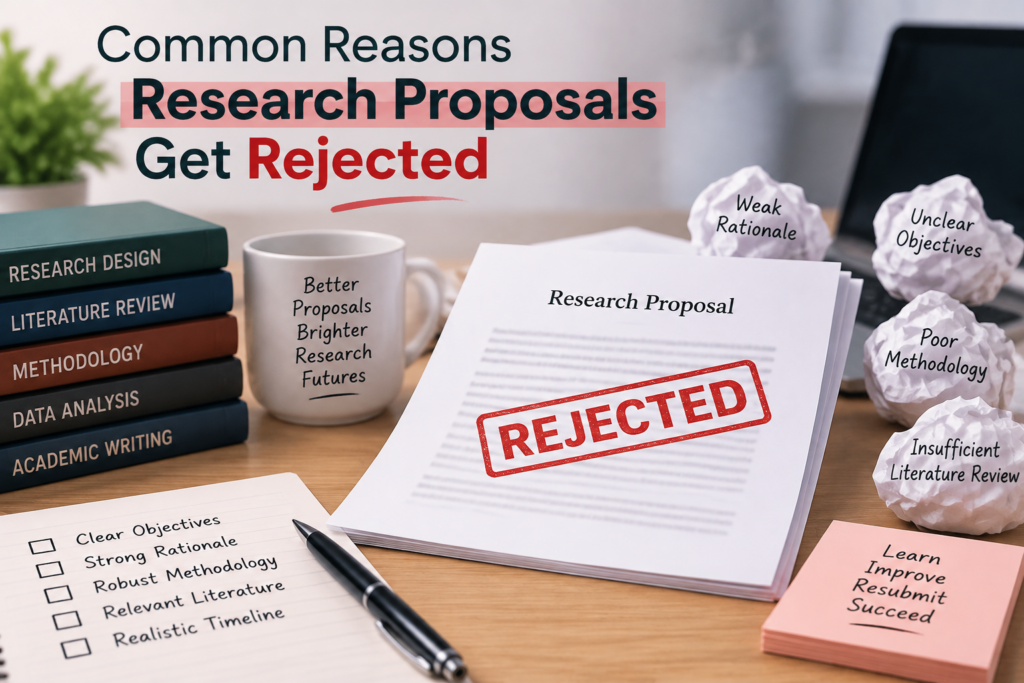
A student may have excellent grades, a genuinely interesting topic, and real motivation – yet still receive a rejection. That can feel confusing because the idea itself may sound strong. The problem is that reviewers do not assess enthusiasm alone. They assess whether the proposed research is clear, significant, feasible, academically grounded, methodologically credible, and suitable for the environment in which it is being proposed.
Oxford’s graduate application guidance notes that, for many research degrees, the proposal is one of the most significant parts of the application and that applicants must follow the specific course requirements. The University of Manchester similarly describes the proposal as crucial to assessment and expects evidence of intellectual purpose, originality, awareness of the research context, clear questions, and a reasoned methodology. Cornell’s guidance for research statements adds another useful perspective: reviewers are moving through many applications and need to see clearly what new knowledge will be generated, why it matters, and why the proposed approach can produce valid conclusions.
That explains why proposals are often rejected for reasons that are preventable. The topic may be relevant, but the question is too broad. The literature may be extensive, but the gap is vague. The method may sound advanced, but it does not answer the research question. The writing may be polished, but the project does not fit available supervision or resources. Sometimes the proposal simply ignores the instructions.
This guide focuses on the most common weaknesses that make reviewers hesitate. It is not a formula for guaranteed acceptance; universities, departments, ethics committees, and funding bodies use different criteria. Instead, it is a practical way to stress-test a proposal before submission so that the reviewer spends less time guessing what you mean and more time evaluating the strength of the research itself.
First: What Reviewers Are Actually Trying to Decide
A proposal is partly an academic argument and partly a risk assessment. Reviewers are asking whether the research question deserves investigation, whether the applicant understands the field, whether the project can realistically be completed, and whether the proposed design is capable of producing evidence that answers the question.
For an admissions application, another question matters: can the department supervise this project? Oxford explicitly advises applicants to pay attention to staff expertise and course-specific assessment criteria. Manchester likewise recommends discussing the proposal with a potential supervisor and checking whether a suitable supervisory team can be identified. A brilliant project can therefore be rejected because it is poorly matched to the institution, not because the idea lacks academic value.
For funding applications, the emphasis can become even more competitive. Reviewers may compare significance, innovation, feasibility, applicant readiness, value for money, and fit with the funder’s priorities. In all cases, the proposal must reduce uncertainty. A reviewer should not have to invent the missing logic for you.
Reviewer question | What a strong proposal shows | Weak signal | Likely concern |
What are you studying? | Focused problem and research question | Large topic with many directions | Lack of focus |
Why does it matter? | Specific academic/practical significance | Generic claim that topic is important | Weak rationale |
What is missing? | Gap grounded in literature | “No one has studied this” without evidence | Poor scholarship |
How will you answer it? | Method aligned with question | Method chosen because it sounds advanced | Invalid design |
Can it be completed? | Realistic sample, access, time, skills, resources | National/global scope with limited time | Feasibility risk |
Why here? | Supervisor/programme/resource fit | Same generic proposal sent everywhere | Poor fit |
1. The Research Problem Is Too Broad
One of the most common rejection risks is a topic that is interesting but not researchable in its current form. ‘Artificial intelligence in education’, ‘mental health among university students’, ‘leadership in healthcare’, or ‘sustainability in business’ are subject areas, not yet focused research problems.
Broad proposals create multiple difficulties at once. The literature review becomes unmanageable, the variables or concepts remain undefined, the population is unclear, the method cannot be designed precisely, and the contribution becomes impossible to state. Reviewers may conclude that the applicant has enthusiasm for a field but has not yet developed an independent research problem.
A focused proposal narrows by population, context, relationship, mechanism, period, outcome, or theoretical lens. The goal is not to make the topic artificially tiny. It is to create boundaries that make systematic investigation possible.
Broad vs researchable |
2. The Research Question Is Vague, Descriptive, or Misaligned
A proposal can have a narrow topic and still have a weak research question. Questions such as ‘What is the role of technology in healthcare?’ or ‘What are the effects of leadership?’ leave too much undefined. Reviewers need to know exactly what phenomenon, relationship, experience, or process you intend to investigate.
Another problem is mismatch. A proposal may ask a causal question but propose a cross-sectional survey that can only establish association. It may ask about lived experience but rely entirely on closed-ended questionnaires. It may promise to evaluate effectiveness without a comparison, baseline, or credible evaluation design.
The research question should drive the method. If the question changes, the design may need to change too. Strong proposals therefore show a visible line from problem -> question -> objective -> data -> analysis -> conclusion.
3. The Literature Review Summarises Studies but Does Not Build a Gap
Reviewers do not need a catalogue of everything you have read. They need evidence that you understand the scholarly conversation and can identify what your project adds. Manchester explicitly expects applicants to show awareness of relevant literature, key arguments, and the ideas and findings of important researchers. Cornell similarly warns that a bibliography should show that you know the discipline well enough to identify the important work and avoid duplicating existing research.
A weak literature review moves source by source: Author A found X. Author B found Y. Author C found Z. A stronger review synthesises patterns: where studies agree, where they conflict, which populations dominate, which methods create limitations, what theories have been used, and which important questions remain unresolved.
The gap should emerge from that synthesis. ‘There is limited research’ is not enough unless you explain limited in what way and why the limitation matters. The gap might be empirical, contextual, theoretical, methodological, population-specific, temporal, or contradictory evidence that has not been resolved.
What a defensible gap sounds like
- Contextual gap: evidence is concentrated in high-income health systems, while the proposed setting has materially different staffing, financing, or service structures.
- Methodological gap: previous evidence relies mainly on cross-sectional self-report surveys, leaving temporal ordering or behavioural outcomes unclear.
- Theoretical gap: the phenomenon has been described extensively, but competing mechanisms have not been tested using an appropriate explanatory framework.
- Population gap: a relevant subgroup is routinely aggregated into broader samples even though its exposure or experience may differ.
- Contradictory evidence: studies report inconsistent relationships, and differences in context, measurement, or design may explain the disagreement.
4. The Proposal Claims Originality Without Demonstrating It
Originality does not always mean discovering a topic nobody has ever mentioned. In many strong projects, the contribution comes from a new context, dataset, method, comparison, theoretical application, mechanism, population, or integration of previously separate literatures.
The problem arises when proposals make large claims such as ‘This is the first study ever’ without a systematic basis. Reviewers who know the field may immediately think of related studies. Overclaiming damages trust.
A safer and stronger approach is precise contribution language: ‘Existing studies have primarily examined X; this project extends that work by testing Y in Z context using…’ This shows awareness rather than exaggeration.
5. The Methodology Sounds Impressive but Does Not Answer the Question
Methods are not decorations. A proposal should not choose PLS-SEM, machine learning, thematic analysis, experiments, mixed methods, or longitudinal modelling simply because the technique sounds advanced. Reviewers want to know why the method is appropriate for the question and data.
A credible methodology section explains the design, population or data source, sampling logic, inclusion and exclusion criteria where relevant, measures or instruments, data-collection procedure, analysis approach, quality or validity checks, and ethical considerations. The level of detail depends on the discipline and proposal length, but the logic should be visible.
Methodological weakness is particularly damaging when the proposal makes conclusions the design cannot support. For example, a one-time observational survey can examine associations but cannot by itself establish that one variable caused another. A tiny convenience sample may support exploratory insight but not broad population estimates. Qualitative interviews can provide depth but should not be written up as though they produce statistical prevalence.
Methodology test |
6. The Project Is Not Feasible
Some proposals are rejected because they are intellectually interesting but practically impossible within the degree, grant, or available resources. Feasibility includes time, access, sample recruitment, data availability, language ability, laboratory capacity, software, funding, ethics, permissions, and the researcher’s technical skills.
A master’s project that proposes interviews across five countries, a national probability survey, two experiments, and a machine-learning component may appear ambitious rather than impressive. A doctoral proposal can be broader, but it still needs sequencing and a plausible plan. Manchester explicitly asks applicants to consider project strategy, timetable, resources, access problems, perceived challenges, and how they will be overcome.
A strong proposal shows that ambition has been converted into a manageable design. It identifies difficult dependencies rather than pretending they do not exist. If access to participants depends on hospitals, schools, police organisations, firms, government departments, or proprietary datasets, explain how access may be obtained and what the alternative is if it fails.
7. The Proposal Does Not Fit the Supervisor, Department, or Funding Call
Fit is one of the most underestimated reasons a good proposal can fail. Research degrees depend on appropriate supervision. Funding applications depend on scheme priorities. A proposal may be high quality yet unsuitable for the particular place it was sent.
Before applying, examine staff profiles, research groups, facilities, datasets, methodological expertise, and recent publications. If the programme encourages prospective-supervisor contact, use that opportunity to test whether your project can be supported. Oxford specifically tells applicants to review course requirements and departmental staff expertise; Manchester recommends discussing the proposal with an academic before formal submission.
Avoid sending an identical generic proposal everywhere with only the university name changed. Fit should be intellectually credible. Explain which expertise or environment is relevant to the project without turning the proposal into flattery.
8. The Significance Is Generic
Many proposals state that a topic is ‘important’, ‘growing’, ‘under-researched’, or ‘a major global challenge’. Those phrases may be true, but they do not tell reviewers what the study will contribute.
Significance should answer: who gains what new knowledge, and why does that knowledge matter? Academic significance may involve theory refinement, resolving conflicting evidence, improving measurement, or extending a model to a meaningful new setting. Practical significance may involve policy, professional practice, service design, decision-making, or intervention development.
Avoid promising to ‘solve’ a large social problem when the project can realistically make a narrower contribution. Credible significance is more persuasive than inflated impact language.
9. The Objectives, Questions, Hypotheses, and Analysis Do Not Match
Internal inconsistency is a major warning sign because it suggests the proposal has been assembled section by section without one coherent research design. The title may focus on trust, the objectives may include satisfaction, the hypotheses may introduce loyalty, and the methodology may measure none of them adequately.
Create an alignment table before submission. Every major construct or phenomenon in the title should appear for a reason. Every research objective should be answered by at least one question. Every hypothesis should have measurable variables and an analysis capable of testing it. Every method should contribute to an objective rather than being included because it is available.
Objective | Research question / hypothesis | Evidence needed | Analysis |
Assess whether workplace incivility is associated with turnover intention | RQ1/H1: Is incivility associated with turnover intention? | Validated incivility and turnover-intention measures | Correlation/regression appropriate to design and assumptions |
Explore how staff interpret uncivil encounters | RQ2: How do staff describe the meaning and consequences of incivility? | Interview narratives | Qualitative coding/thematic analysis |
10. Ethical and Access Issues Are Treated as an Afterthought
A proposal becomes difficult to trust when it involves vulnerable participants, sensitive records, covert observation, confidential organisations, minors, health data, or potentially distressing topics but says little about ethics and access.
You do not need final ethics approval at the proposal stage unless the programme specifically requires it, but you should demonstrate awareness of consent, confidentiality, privacy, data security, withdrawal, risk, power relationships, and organisational permission where relevant.
Ethical feasibility and methodological feasibility are connected. If a proposed dataset cannot lawfully or realistically be accessed, the method is not feasible no matter how elegant the analysis plan looks.
11. The Writing Is Jargon-Heavy, Rambling, or Difficult to Follow
Cornell advises proposal writers to remember that reviewers may not be specialists in the exact subfield and to avoid unnecessary jargon. Manchester likewise warns that poorly specified, jargon-filled, or rambling proposals are unlikely to persuade assessors that the applicant has a clear plan.
Complex research does not require complicated prose. Clear writing demonstrates intellectual control. Define specialised terms, use informative headings, keep paragraphs focused, and make the relationship between sentences explicit. A reviewer should be able to identify the problem, gap, question, method, and contribution after a rapid first read.
Long introductions are a common problem. A proposal can spend half its word count describing the general importance of a topic and then rush through the actual research design. The background should lead efficiently toward the gap and research question.
12. The Proposal Ignores the Application Instructions
This is one of the most avoidable reasons for failure. Different programmes specify different word limits, headings, document types, citation expectations, proposal components, and supervisor-contact rules. Oxford warns that a proposal significantly exceeding the stated permitted length may be removed and the application treated as incomplete. Manchester schools likewise publish specific proposal limits and structures.
Do not assume a proposal that worked for one institution can be submitted unchanged elsewhere. The first document you should read is the programme’s own application guidance. Build your draft around those requirements rather than forcing an old proposal into a new template.
13. The Bibliography Is Weak, Outdated, or Inaccurate
The reference list is evidence of scholarly preparation. Reviewers notice when key foundational or recent studies are missing, when citations do not support the claims they are attached to, when references are inconsistent, or when the bibliography looks automatically generated rather than carefully selected.
A good proposal does not need the longest bibliography. It needs the right bibliography. Include the literature necessary to establish the problem, the debate, the gap, the theoretical or conceptual lens, and the methodological basis. Verify every DOI, author name, year, title, and source before submission.
If your field is moving quickly, recent literature matters. If the project depends on an established theory, foundational sources matter too. ‘Last five years only’ is not automatically academically superior when older seminal work defines the theory or method.
14. The Timetable Is Either Missing or Unrealistic
A timeline shows whether the applicant understands the sequence of research. Ethical review must precede certain types of data collection. Data cleaning or transcription must precede final analysis. Analysis must be sufficiently complete before the results and discussion can be finalised.
Weak timelines allocate equal time to every chapter or compress recruitment, analysis, writing, and revision into unrealistic blocks. Strong timelines are dependency-based and include buffer time for permissions, recruitment difficulties, supervisor feedback, equipment delays, or data problems.
The timetable does not need to predict the future perfectly. Its purpose is to show that the project has been thought through as a process rather than as a topic.
15. The Proposal Sounds Generated Instead of Thought Through
This is becoming an increasingly visible risk. Polished language can hide weak intellectual ownership. Manchester’s current proposal guidance specifically warns applicants against relying on generative AI-produced content and says successful proposals should demonstrate a clear original idea, critical engagement with literature, awareness of academic context, and a well-reasoned study approach.
The issue is not merely writing style. A proposal assembled from generic language often contains hidden inconsistencies: variables change names, citations do not support claims, methods do not match objectives, or the claimed gap is not visible in the literature. Reviewers may interpret these as signs that the applicant does not yet understand the project well enough to conduct it independently.
Use digital tools, where permitted, to support organisation, language checking, literature management, or planning – but verify everything and ensure the final intellectual decisions are yours. Always follow the institution’s current policy on AI assistance and disclosure.
A Before-and-After Example
Weak proposal logic |
Stronger proposal logic |
The stronger version is not better because it uses more sophisticated vocabulary. It is better because the scope, gap, variables, population, limitation of causal inference, and analytical purpose are easier to see.
That is the standard to aim for throughout the proposal: specificity that makes the research logic visible.
A 10-Minute Research Proposal Rejection-Risk Audit
- ☐ Can I state the research problem in two sentences without using vague words such as ‘impact’, ‘role’, or ‘issues’ unless I define them?
- ☐ Does the literature review demonstrate a gap rather than simply assert one?
- ☐ Is the contribution realistic and specific?
- ☐ Do the title, problem, objectives, research questions, hypotheses, variables/concepts, and methods align?
- ☐ Can every research question be answered by the data I propose to collect or access?
- ☐ Am I making causal claims that my design cannot support?
- ☐ Is the sample/data access realistic within the available time?
- ☐ Have I identified important ethics, permissions, and confidentiality issues?
- ☐ Does the project fit the supervisor, department, facilities, and programme?
- ☐ Have I followed the exact word count, formatting, and content requirements?
- ☐ Are the key references current, accurate, and relevant, with foundational sources included where needed?
- ☐ Can an intelligent non-specialist understand the core argument on a first read?
- ☐ Does the timetable include dependencies and buffer time?
- ☐ Have I removed claims that sound impressive but cannot be defended?
- ☐ Does the final proposal sound like a project I personally understand well enough to explain in an interview?
How to Strengthen a Proposal Before Submission
- Read the programme’s own proposal instructions before editing anything else.
- Write a one-paragraph project summary containing problem, gap, question, method, and contribution. If this paragraph is unclear, the full proposal will probably be unclear too.
- Build an alignment table linking each objective to a question, data source, and analysis method.
- Test the gap against the literature. Search specifically for studies that might disprove your claim that the gap exists.
- Ask a potential supervisor or knowledgeable academic whether the scope and method are realistic, where permitted.
- Ask a reader outside your narrow subfield to mark any sentence they cannot understand on first reading.
- Cut generic background material and use the space to explain research logic, feasibility, and contribution.
- Verify every reference and every factual claim.
- Leave time between drafting and submission. Cornell notes that competitive proposals benefit from repeated drafting, feedback, revision, and proofreading.
- Do a final compliance check against the application page rather than relying on memory.
Useful Backlinks for Research Proposal Writing
- University of Oxford – Research Proposal Guidance – Official guidance on course-specific requirements, proposal importance, supervisor fit, originality, length, and application compliance.
- University of Manchester – How to Write a Research Proposal – Covers title, literature, questions, methods, project strategy, timetable, significance, originality, and supervisor discussion.
- University of Manchester School of Social Sciences – Writing Your Proposal – Includes practical pitfalls to avoid and current guidance on proposal ownership and responsible use of AI.
- Cornell Graduate School – Writing Your Research Statement – Useful reviewer-focused guidance on clarity, significance, validity, bibliography, feedback, and proofreading.
Final Thought: Make It Easy for the Reviewer to Trust the Project
Research proposals are not rejected only because the topic is unimportant. They are rejected when the proposal leaves too many important questions unanswered. What exactly is the problem? What does the literature fail to explain? Why is the research question worth asking? Why is this design capable of answering it? Can the study actually be completed? Why is this programme, supervisor, or funding call the right place for it?
A strong proposal answers those questions in a connected sequence. It does not rely on inflated originality claims, complicated terminology, or an impressive list of methods. It demonstrates intellectual control: the applicant understands what is known, what is uncertain, what evidence is needed next, and what limits the proposed design.
Before submitting, read the proposal one final time from the reviewer’s perspective. Remove anything that creates unnecessary doubt. Clarify what is vague. Narrow what is unmanageable. Align what is inconsistent. Verify what is unsupported. The aim is not to make the project sound perfect; it is to make it sound thoughtful, credible, and researchable.
Preparing a research proposal for admission, funding, or supervisor review? |
CLARIFY THE PROBLEM. PROVE THE GAP. ALIGN THE METHOD.
Need structured support with critical academic reading?
KM Academic Success offers professional guidance and editing support for students working on theses, dissertations, and research papers, helping ensure your work is genuinely well-crafted, properly cited, and submission-ready with confidence. Learn more at KM Academic Success.