
BLOGS
Using Citation Chaining to Find Better Sources Faster
You find one article that feels almost perfect for your dissertation. The topic matches. The theory is relevant. The authors cite studies you have not seen before. Then you notice that newer papers have cited it too.
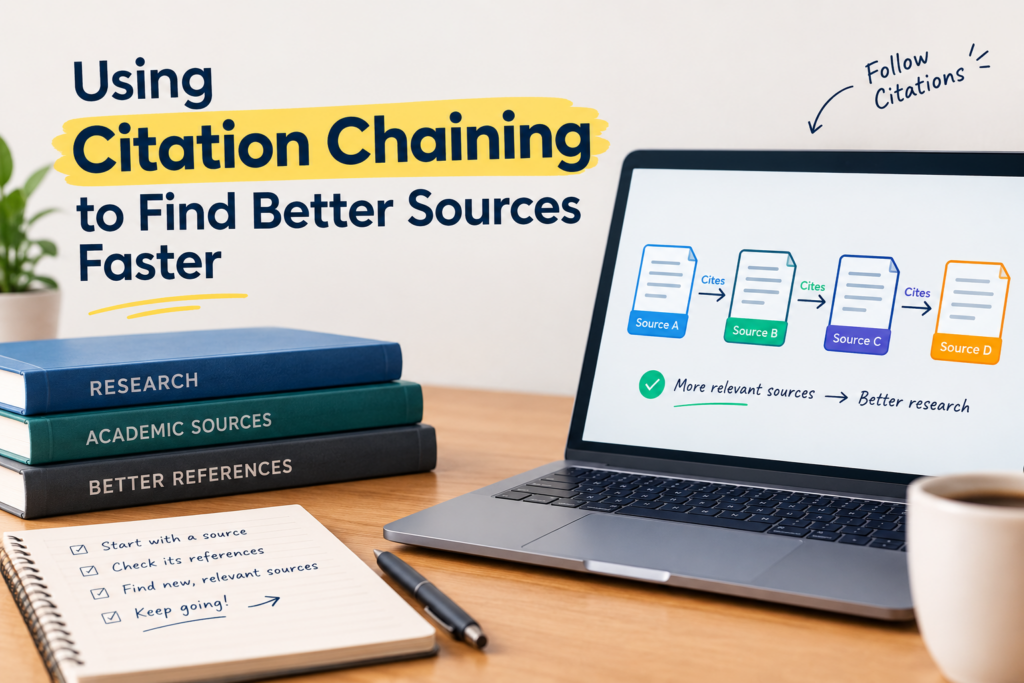
That single paper can become more than a source. It can become a map.
This is the idea behind citation chaining. Instead of starting every literature search from a fresh list of keywords, citation chaining follows the relationships between papers. You look backward at the studies a useful paper cited, then forward at the studies that later cited it. In a few minutes, one strong article can lead you into the research conversation that surrounds it.
For students who feel stuck with the same database results, citation chaining can be one of the fastest ways to find better sources. It is especially useful when terminology changes across studies, when a topic has several competing labels, or when your first keyword search keeps returning broad material.
The important point is that citation chaining is not a replacement for careful searching. It is a way to strengthen it.
The 30 Second Answer
Citation chaining means using one relevant source to find other relevant sources connected to it through citations.
Backward citation chaining means checking the reference list of a useful paper to find older research that informed it.
Forward citation chaining means finding newer papers that have cited that useful paper.
Together, these two directions help you move through a topic across time. You can trace where an idea came from, see how later researchers developed or challenged it, and discover papers that may never have appeared in your original keyword search.
Why Citation Chaining Works So Well
Keyword searching depends on language.
If you search for “student engagement in online learning,” a database looks for records that match the terms, subject headings, or related indexing used in that system. The problem is that researchers do not always use the same language for the same idea.
One paper may use “online learning engagement.” Another may discuss “digital participation.” A third may focus on “learner involvement in virtual classrooms.” All three could be relevant, but a narrow keyword strategy may not retrieve them equally well.
Citation chaining follows scholarly relationships instead of relying only on wording.
The University of Sydney’s citation chaining guide explains that the technique can uncover resources that a traditional structured search may miss by exploring both the references within a key paper and the newer work that cites it.
That is why citation chaining is so useful once you have found one or two genuinely strong papers. Those papers have already been placed inside a network of related research.
The Seed Paper Is Everything
Citation chaining usually begins with a seed paper, sometimes called a key paper.
A seed paper should be highly relevant to your research question. It should not be chosen simply because it has a famous author, a high citation count, or a title that sounds impressive.
Ask whether the paper actually helps you understand the exact problem you are researching.
Does it examine the right concept? Does it use a relevant population or context? Does it apply a theory you are considering? Does it review an important part of the field? Does it contain references that seem closely connected to your topic?
The better the seed paper, the more useful the citation chain is likely to become.
For an ordinary dissertation search, you may begin citation chaining from two or three strong papers rather than only one. This reduces the risk of allowing a single author’s perspective to shape your entire search.
Backward Citation Chaining: Follow the Conversation Into the Past
Backward citation chaining is the simplest direction because the evidence is already in front of you.
Open the reference list of your seed paper.
Do not automatically download every source. Scan the titles and look for studies that appear directly relevant to the argument, theory, method, instrument, or historical development of your topic.
Suppose your seed paper examines transformational leadership and employee retention. Its references may lead you to the original transformational leadership theory, earlier studies linking leadership with organisational commitment, established employee retention measures, or research from different industries.
This is how citation chaining can help you find foundational research faster.
The University of Nottingham’s citation searching guidance describes backward searching as following the cited references from a key paper into older research. This can help students identify original or seminal work rather than repeatedly citing a recent article that is itself summarising older scholarship.
That distinction matters. If a recent paper says a theory was introduced decades ago, it is often better to locate the original theoretical source where practical rather than relying only on a secondary description.
Forward Citation Chaining: See What Happened Next
Backward searching shows where the paper came from. Forward citation chaining shows where the conversation went after it was published.
You search for the seed paper in a citation database or Google Scholar and look at the papers that cite it.
Google Scholar’s Cited by feature allows researchers to open a list of newer works that reference a particular result. This makes forward citation chaining especially accessible to students who do not have specialist citation databases available at home.
Imagine your seed paper was published in 2019. It may have proposed a model that later researchers tested in different countries. Another paper may have criticised the model. A 2024 study may have added a mediator. A 2025 study may have replicated it with a larger sample.
Citation chaining therefore helps you avoid a common literature review problem: treating an older influential paper as though the academic conversation stopped when it was published.
Better research asks what happened next.
Citation Chaining Is More Than Clicking “Cited By”
The technique becomes powerful when you make decisions rather than simply opening links.
When Citation Chaining Saves the Most Time
Citation chaining is especially useful after your first database search.
Your initial search gives you the vocabulary of the field. You begin recognising authors, theories, journals, measures, and recurring debates. Once you know which papers are genuinely central, citation chaining can expand the search much faster than repeatedly inventing new keyword combinations.
It can be particularly useful for topics with inconsistent terminology.
A 2024 study evaluating citation databases notes that citation searching can retrieve unique research where language based searching struggles because concepts are described using different or changing terms.
This is common in management, education, psychology, social sciences, and emerging technology topics where the same concept may appear under several labels.
Citation chaining can also help when your supervisor tells you that your sources are too old. Instead of starting again, run forward citation chaining from the strongest older papers and look for later research that developed the same ideas.
A Practical Citation Chaining Workflow
The easiest method is to treat citation chaining as a controlled loop.
Start with your research question. Run a normal database or Google Scholar search. Identify two or three papers that are highly relevant. Save their full citation details.
For each seed paper, inspect the reference list. Select older sources that are directly related to your concepts, theories, measures, or methods.
Then perform forward citation chaining. Use Google Scholar, Scopus, Web of Science, or another available citation index to identify newer papers that cited the seed paper.
Screen titles and abstracts before downloading full texts.
Add genuinely relevant papers to your reference manager or research matrix.
Now repeat citation chaining only from the strongest new papers.
This last step matters because uncontrolled chaining can become endless. Your goal is not to follow every connection. Your goal is to identify a defensible body of literature efficiently.
How to Use Google Scholar for Citation Chaining
Google Scholar is one of the easiest tools for students because it is freely accessible.
Search the exact title of your seed paper. Under the result, look for the Cited by link. Open it to see newer papers that Google Scholar has identified as citing the seed source.
You can then search within those citing results by adding a term relevant to your research question. For example, if a leadership paper has hundreds of citing documents, you might search within the results for “healthcare,” “Malaysia,” or “employee retention.”
Google Scholar also offers Related articles, which can help you move sideways toward similar work even when there is no direct citation relationship.
For backward citation chaining, open the seed paper itself and inspect its reference list. Search promising titles in Scholar to locate the paper and see whether an accessible version exists.
What About Scopus and Web of Science?
If your university provides access, Scopus and Web of Science can make citation chaining more structured through citation tracking, filters, export tools, and indexed records. They are useful when you need to manage a larger search more systematically.
No citation database captures everything, however. Coverage differs by discipline, publisher, language, and document type, so one platform should not be treated as a complete map of the literature.
Citation Chaining for a Literature Review
Citation chaining is extremely useful when a literature review feels descriptive or disconnected.
Suppose you already have five papers about remote work and employee productivity. Keyword searching may keep giving you more papers that look similar.
Citation chaining can show which studies those authors repeatedly rely on. You may discover a foundational theory, an older measurement study, or a major review that explains why the field developed in a particular direction.
Forward citation chaining can then reveal whether later research confirmed or challenged those conclusions.
This allows your literature review to move beyond “Author A found this and Author B found that.” You begin to see relationships across time.
Which paper introduced the idea? Who tested it? Who disagreed? Which methods produced different results? Which contexts remain underexplored?
Citation chaining therefore supports synthesis, not just source collection.
Citation Chaining for Systematic Reviews Needs More Discipline
Students sometimes hear that citation chaining is useful and assume they can replace database searching with it in a systematic review.
That is not a safe assumption.
For systematic reviews, citation chaining is generally a supplementary search technique rather than an excuse to skip a planned database strategy. The TARCiS statement on citation searching provides formal guidance on terminology, application, and reporting, including backward and forward citation searching.
Cochrane guidance also treats citation searching and reference list checking as important supplementary methods that should be documented transparently when used.
If you are completing a systematic review, follow your protocol, discipline guidance, PRISMA requirements where applicable, and supervisor instructions. Record which seed papers were used, which citation indexes were searched, when the search was conducted, and how records were screened.
Citation chaining becomes academically stronger when another researcher could understand how you did it.
The Risk of Citation Bias
Citation chaining has one important weakness: it follows existing networks.
Highly visible papers are more likely to be cited, which means citation chaining can repeatedly lead you through the same influential group of authors or journals.
That can create a narrow view of the field.
A paper from an underrepresented country, a newer journal, a negative result, or a study using different terminology may sit outside the main citation network.
This is why citation chaining should complement keyword searches rather than replace them.
Use database searching to discover material based on concepts. Use citation chaining to discover material based on scholarly connections. The two methods catch different things.
The strongest search strategy often uses both.
Do Not Confuse Citation Count With Source Quality
Students often assume that a paper with 3,000 citations must be better than a paper with 30.
Citation counts do not work that way.
Older papers have had more time to accumulate citations. Some fields cite more heavily than others. Review articles naturally receive many citations. Controversial papers may be cited repeatedly because researchers disagree with them.
When citation chaining leads you to a source, evaluate it normally.
Check the journal or publisher. Read the abstract. Examine the research design. Look at the sample. Consider the date. Ask whether the methods fit the claim. Check whether the source is directly relevant to your question.
Citation chaining helps you discover sources. It does not evaluate them for you.
A Realistic Student Example
Imagine Aisha is writing a dissertation about academic stress and social media use among university students.
Her first keyword search produces hundreds of results. Many are about general screen time, adolescent mental health, or social media addiction. Only a small number directly match her question.
She identifies a 2023 paper that examines social media use and academic stress in university students.
Backward citation chaining leads her to an older scale development paper, a study on academic stress measurement, and several earlier papers that shaped the 2023 authors’ argument.
Forward citation chaining shows that the 2023 paper has since been cited by newer research on short form video use, sleep disruption, and academic wellbeing.
Aisha does not use every paper she finds. She screens them against her research question and inclusion needs.
In less time than another broad keyword search would have taken, citation chaining gives her a clearer picture of the field’s history and recent direction.
That is what makes the technique valuable.
Common Citation Chaining Mistakes
The biggest mistakes are starting with a weak seed paper, downloading everything without screening, assuming a highly cited source is automatically the best source, and following only one direction of the citation trail.
Backward searching helps uncover foundations, while forward searching keeps the review current. You should also record what you did and continue using keyword searches because citation networks can miss research outside the most visible scholarly conversations.
A Five Minute Citation Chaining Check
When you find a paper that looks unusually useful, do this before closing the tab.
Check its reference list for three to five sources directly connected to your topic.
Search the paper title in Google Scholar and open Cited by.
Filter the citing results mentally by your population, context, theory, or key concept.
Save only the strongest candidates.
Add any useful new search terms you discover to your keyword list.
That five minute habit can turn one good source into several better ones.
Citation Chaining FAQs
Is citation chaining the same as snowballing?
The terms are often used in overlapping ways. You may also see citation searching, citation chasing, pearl growing, reference harvesting, backward searching, and forward searching. In formal review work, use the terminology required by your methodology or reporting guidance.
Is citation chaining acceptable in academic research?
Yes. Citation chaining is a recognised literature discovery technique. The level of documentation needed depends on whether you are writing an ordinary assignment, dissertation, scoping review, systematic review, or another form of evidence synthesis.
Can I do citation chaining only with Google Scholar?
For many student projects, Google Scholar can be useful for forward citation searching through Cited by and for locating papers found in reference lists. If your university provides Scopus, Web of Science, or subject databases, these can provide additional citation searching options.
How many seed papers should I use?
There is no universal number for ordinary academic work. Starting with two or three highly relevant papers is often more sensible than relying on one source. Formal systematic searches may require a more defined approach.
Does citation chaining find better sources than keywords?
Not automatically. Citation chaining and keyword searching find literature in different ways. Citation chaining follows scholarly links, while keyword searching follows concepts and terminology. Using both is usually stronger than relying entirely on either method.
Can citation chaining help me find newer sources?
Yes. Forward citation chaining is particularly useful for finding research published after an influential paper.
Can citation chaining help me find seminal sources?
Yes. Backward citation chaining often leads toward earlier theory papers, foundational methods, and original studies, but you should read and evaluate the sources rather than assuming they are seminal simply because they are old or frequently cited.
The Bottom Line
Citation chaining is one of the simplest ways to make a literature search smarter once you have found a genuinely useful paper.
Backward citation chaining shows you the research that shaped that paper. Forward citation chaining shows you the research that came after it. Together, they help you trace the development of ideas, find foundational studies, locate newer evidence, discover alternative terminology, and build a more connected understanding of your topic.
The best use of citation chaining is selective.
Start with strong seed papers. Follow references that are directly relevant. Use Cited by tools to find newer work. Screen every source. Record what you did. Keep keyword searching alongside the citation network.
Most importantly, do not treat citation chaining as a shortcut around critical thinking.
It saves time because it helps you navigate the scholarly conversation more intelligently, not because every paper connected by a citation automatically belongs in your dissertation.
Once you start seeing references as pathways instead of decorations at the end of an article, literature searching becomes much easier to control.
Further Reading and Academic Research Resources
- University of Sydney: Citation Chaining
- University of Nottingham: Citation Searching
- Google Scholar: Search Help and Cited By Guidance
- Cochrane Handbook: Searching for and Selecting Studies
- Scopus Support: Citation Overview and Citing Documents
- University of Central Florida: Getting the Most Out of Google Scholar
Need structured support with critical academic reading?
If citation chaining is helping you find more papers but your literature review still feels scattered, repetitive, or difficult to organise, KM Academic Success can help you strengthen the research process behind your own original work. KM Academic Success provides ethical academic guidance for literature searching, literature reviews, dissertation structure, methodology, referencing, proofreading, and research writing. The aim is to help students make stronger research decisions, organise evidence clearly, and build academic arguments they understand and can defend.