
BLOGS
Literature Review vs Background Chapter: Are They the Same Thing?
Literature Review vs Background Chapter is not simply a question of chapter titles. It is a question of purpose. Once you understand the purpose of each section, decisions about structure, evidence, theory, definitions, and the research gap become much easier.
If you have ever moved the same paragraph between Chapter 1 and Chapter 2 three or four times, you are not alone. Many dissertation writers know that background and literature review sections are related, but they are unsure where one ends and the other begins.
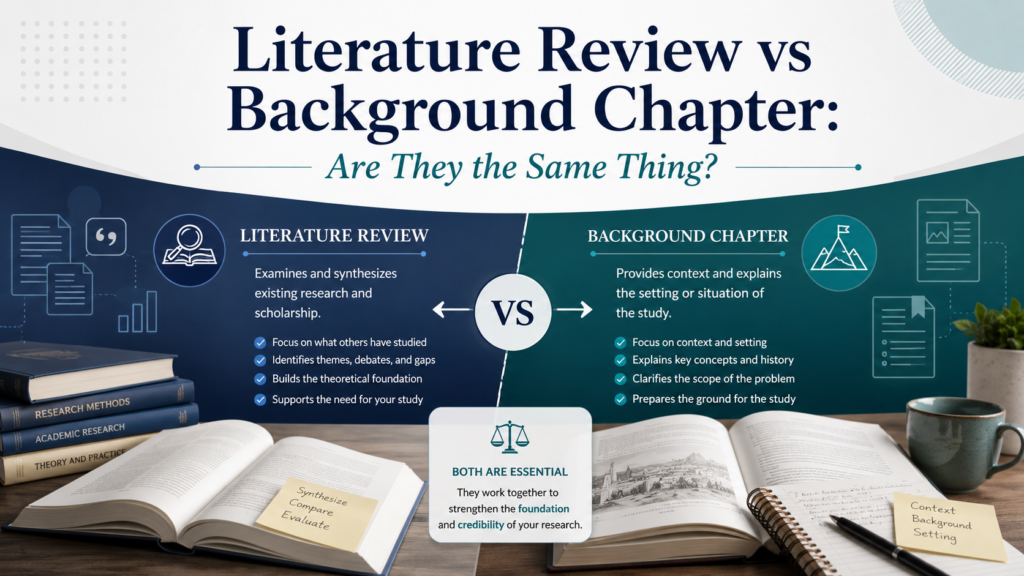
That confusion matters because the two sections may use similar sources while doing different academic jobs. A background chapter helps the reader understand the setting, problem, and relevance of the study. A literature review examines what scholars already know, where they disagree, how convincing the evidence is, and what is still missing.
So, Literature Review vs Background Chapter is not simply a question of chapter titles. It is a question of purpose. Once you understand the purpose of each section, decisions about structure, evidence, theory, definitions, and the research gap become much easier.
The Short Answer
Literature Review vs Background Chapter is easier to manage once you separate context from evaluation. Literature Review vs Background Chapter can be remembered in one sentence: background creates context, while the literature review evaluates the academic conversation.
The background answers questions such as: What is happening? Where is the problem located? Why does it matter? What does the reader need to know before understanding the study?
The literature review answers different questions: What has already been studied? What patterns appear across the evidence? Where do researchers agree or disagree? What theories or methods shape the debate? What remains unresolved?
Some universities combine these functions in one chapter. Others separate them. Oxford guidance on writing literature reviews notes that a literature review can appear as a standalone chapter or under labels such as Background, Theoretical Framework, or Research Context, depending on the discipline and project. That is why Literature Review vs Background Chapter should never be decided by a generic template alone.
What a Background Chapter Is Really Doing
A background chapter prepares the reader for the research problem.
Imagine a dissertation examining employee turnover in the UK hospitality industry. Before the reader can evaluate research on turnover, they may need to understand workforce shortages, working conditions, industry characteristics, recent labour pressures, and why retention has become a practical concern.
That material gives the study a setting.
In Literature Review vs Background Chapter, the background section often moves from broad context toward a specific problem. It can explain the development of an issue, introduce key terminology, provide relevant statistics, describe a geographical or organisational setting, and show why the topic deserves attention.
A background chapter is not a storage space for every interesting fact you found. If a paragraph does not help the reader understand the setting, scope, or importance of the problem, it probably does not belong there.
What Makes a Literature Review Different
A literature review is not just more background with more citations.
It is a structured and critical discussion of scholarship.
The University of Sheffield guidance on organising and synthesising a literature review recommends bringing sources together thematically, identifying relationships between them, and using synthesis to show what the body of literature collectively suggests. This captures the core difference in Literature Review vs Background Chapter.
A weak literature review often sounds like this:
Smith found one result. Jones found another. Ahmed studied a different sample. Brown used a different method.
Each sentence may be accurate, but the reader is left to connect the studies. A stronger review brings them together, compares evidence, and explains why findings differ. In Literature Review vs Background Chapter, that analytical comparison is what makes the literature review more than description.
At a Glance: Literature Review vs Background Chapter
Area | Background Chapter | Literature Review |
Main purpose | Establish context and explain the research problem | Analyse and synthesise existing scholarship |
Main question | What does the reader need to know about the setting and problem? | What does research already tell us and what remains unresolved? |
Typical evidence | Statistics, reports, definitions, policy, industry context, selected academic studies | Mainly academic studies, theories, empirical evidence, and scholarly debates |
Typical movement | Broad context toward the specific problem | Established knowledge toward debates, limitations, and the research gap |
Critical analysis | Usually selective and limited | Central to the chapter |
Research gap | May prepare the reader for it | Usually demonstrates and justifies it |
Best test | Does this help the reader understand my problem? | Does this help the reader understand the state of knowledge? |
Can the Same Source Appear in Both Sections?
Yes. A source belongs to a section because of how you use it, not because of what type of source it is.
Suppose a published study reports a sharp increase in staff turnover in a specific sector.
In the background chapter, you may cite that study to show that turnover is a serious practical issue. The source establishes context.
In the literature review, you may return to the same study and compare its findings with other research. You might discuss its sample, measurement, theory, or limitations.
The citation is the same, but the academic function changes.
This is an important Literature Review vs Background Chapter principle because students sometimes assume that academic journal articles automatically belong in the literature review and reports automatically belong in the background. The better question is: what job is this evidence doing in my argument?
Why Students Mix the Two Up
Both sections can define concepts, use academic sources, discuss previous developments, and lead toward the research question. The difference is the level and purpose of analysis.
A common Literature Review vs Background Chapter mistake is writing the background as a miniature literature review. The student starts evaluating disagreements, methods, and theoretical debates before the main review even begins.
The opposite problem also happens. The literature review becomes an extended background chapter full of definitions, history, statistics, and general context, but very little synthesis.
The University of Queensland advises writers to limit background information in a literature review to what is needed to orient the reader and support the argument. That is especially useful for Literature Review vs Background Chapter because it provides a practical boundary: context should support the review, not replace it.
Do You Always Need Two Separate Chapters?
No.
There is no universal dissertation structure.
One university may require:
Chapter 1: Introduction and Background
Chapter 2: Literature Review
Chapter 3: Methodology
Another may require:
Chapter 1: Introduction
Chapter 2: Background and Literature Review
Chapter 3: Methodology
A third programme may integrate a brief review into the introduction. Literature Review vs Background Chapter therefore depends partly on disciplinary convention and institutional guidance.
The University of Kent notes that literature review structure and length vary by level and discipline, and students should use programme requirements and supervisor guidance. That means a blog can help you understand the function, but your handbook determines the final architecture.
How to Write a Strong Background Chapter
A strong background chapter narrows gradually.
Start with the broader issue. Then introduce the specific context. Explain the practical or academic problem. Show why the issue matters. Move toward the particular study.
For Literature Review vs Background Chapter, a useful background sequence can be:
Current context
Specific setting
Nature of the problem
Scale or significance of the problem
Relevant concepts
Reason the study is needed
Suppose your research examines digital transformation in small retail businesses.
Your background might explain what digital transformation means in the context of small firms, why smaller retailers face particular technology pressures, how customer behaviour has changed, and what practical difficulties motivate the study.
You probably do not need several pages on the entire history of computing.
Literature Review vs Background Chapter becomes clearer when every background paragraph has a visible purpose. Ask: what does the reader understand now that they did not understand before?
How to Write a Strong Literature Review
The literature review needs a different mindset. Instead of asking, “What did this paper say?” ask, “What does this group of studies tell me?” That change makes Literature Review vs Background Chapter an analytical issue rather than a formatting one.
Organise literature around themes, concepts, debates, theories, variables, methods, or meaningful stages in the development of knowledge. Do not automatically give each study its own paragraph.
For example, if ten studies examine employee engagement, you might organise the review around leadership, job design, organisational support, workplace flexibility, and reward systems.
Within each theme, compare the evidence.
Ask whether studies agree, why they differ, whether samples or measures changed, and whether context or research design influenced the result. This is the critical work that should dominate the literature review.
Literature Review vs Background Chapter is therefore also a difference in intellectual task. Background writing selects context. Literature review writing synthesises and evaluates evidence.
The Biggest Literature Review Mistake: One Source, One Paragraph
One of the easiest ways to recognise a weak literature review is the repeated author by author pattern. The paragraph contains citations but no argument.
A better approach is synthesis.
Start with a claim or theme. Bring several studies into the same discussion. Show agreement, disagreement, progression, methodological difference, or a gap. Then explain what the combined evidence means for your study.
This is why Literature Review vs Background Chapter cannot be judged by citation count. A chapter with sixty references can still be descriptive if the sources never interact.
A strong review makes relationships visible.
Where the Research Gap Belongs
The research gap normally emerges most clearly from the literature review.
A background chapter may establish that a practical problem exists. It may show that a sector is changing, a population faces a challenge, or a policy issue deserves attention.
But a research gap is a claim about knowledge.
Literature Review vs Background Chapter becomes especially important here because students often confuse a practical problem with an academic gap.
“There is high employee turnover” is a practical problem.
“Existing studies have examined turnover mainly in large hospitals, while evidence from small private clinics in this region remains limited” is closer to a research gap.
The literature review should demonstrate that gap through the studies you have reviewed.
A convincing gap may come from a neglected population or context, contradictory findings, inconsistent measurement, limited theory, or methodological weakness. Do not simply announce that “few studies exist.” Show the reader how you know.
Theory: Background or Literature Review?
It can be either, depending on the role theory plays.
In Literature Review vs Background Chapter, a brief theoretical introduction may appear in the background if the reader needs it for context. A fuller theoretical discussion usually belongs in the literature review or a separate theoretical framework section, where you can examine how previous researchers used the theory, what it explains, and how it connects to your study.
What About Definitions?
Definitions can also appear in both places. A background chapter may need a concise working definition. A literature review may compare competing definitions when the meaning of a concept affects the evidence. Literature Review vs Background Chapter therefore asks not only, “Am I defining a term?” but “Why am I defining it here?”
How to Decide Where a Paragraph Belongs
When you are unsure, ignore the citation count and examine the paragraph’s job.
Ask these questions.
Am I mainly explaining the setting or practical context?
If yes, background is likely.
Am I mainly comparing what researchers have found?
That points toward the literature review.
Am I evaluating theories, methods, limitations, contradictions, or gaps?
That strongly suggests literature review work.
Am I providing a definition because the reader needs basic orientation?
That may belong in the background.
Am I comparing definitions because scholars conceptualise the term differently?
That belongs more naturally in the literature review.
This Literature Review vs Background Chapter test works because it focuses on function rather than labels.
You can also use the “so what?” question.
If the answer is “the reader now understands the research setting,” the paragraph is probably background.
If the answer is “the reader now understands what scholarship shows, disputes, or has not yet resolved,” the paragraph is probably literature review.
One final way to check Literature Review vs Background Chapter is to imagine the reader entering your study for the first time. Literature Review vs Background Chapter should first make the problem understandable and then make the knowledge gap defensible. When Literature Review vs Background Chapter is handled well, the chapters feel connected without repeating the same academic work.
A Practical Example
Consider this research question:
How does transformational leadership influence employee retention in UK healthcare organisations?
The background chapter might explain workforce retention pressures in healthcare, why turnover matters for service delivery, and why leadership is a relevant organisational issue.
The literature review would then examine research linking transformational leadership with retention.
Some studies may suggest a direct relationship. Others may argue that job satisfaction, organisational support, workload, or career development mediate or moderate the relationship.
The review can compare where studies were conducted, how leadership was measured, which employee groups were sampled, and whether findings are consistent.
The eventual gap may be that a specific workforce, setting, or combination of variables has received limited attention.
This Literature Review vs Background Chapter example shows the progression clearly.
Background explains why the topic matters.
Literature review explains what is known and why another study is justified.
Common Mistakes That Blur the Boundary
Common problems include an overlong background, a review that lists studies without synthesis, repeated definitions or statistics, and a research gap that is announced rather than demonstrated. Another Literature Review vs Background Chapter mistake is assuming that critical writing means negative writing. Critical analysis can identify strengths, limitations, contradictions, patterns, and uncertainty. Your course handbook and supervisor should always take priority over a general online article.
A Pre Submission Audit
Read the background chapter by itself.
Can the reader identify the setting, problem, importance, and scope of the study?
Now read the literature review.
Are sources grouped around meaningful themes?
Do studies interact with each other?
Can the reader see patterns, disagreements, limitations, theories, or methodological differences?
Does the review move toward a clear gap or justification for the study?
Then read both sections together.
For Literature Review vs Background Chapter, look specifically for repetition. If a paragraph could move between the two chapters unchanged, ask whether its purpose is clear enough.
Also check the transition. The background should make the research problem understandable, while the literature review should make the knowledge problem understandable. Together, they should show why the study matters in practice and academically.
Frequently Asked Questions
Is Literature Review vs Background Chapter really a major difference?
Yes. The sections can overlap, but they normally perform different functions. Background establishes context. Literature review evaluates existing scholarship.
Can a background chapter contain academic sources?
Yes. A background chapter can use academic research, official statistics, policy documents, government reports, and credible industry evidence where they help establish the research context.
Can the same paper appear in both sections?
Yes. In Literature Review vs Background Chapter, the same source can be used differently. It may establish context in the background and later be critically compared with other studies in the literature review.
Does every dissertation need a separate background chapter?
No. Some programmes combine background with the introduction or literature review. Always follow your university’s guidance.
Does every dissertation need a literature review?
Most research dissertations require engagement with existing scholarship, but the location, size, and structure vary by discipline and degree.
How long should each chapter be?
There is no universal word count. Literature Review vs Background Chapter length depends on your total dissertation length, research design, discipline, and programme requirements.
Can I combine the two chapters?
Yes, if your programme permits it. A combined chapter should still make a clear movement from context to critical review and then toward the research gap.
Where should the research gap appear?
The literature review usually provides the strongest evidence for the gap because a gap is a claim about what existing knowledge has not adequately addressed.
What is the easiest way to remember Literature Review vs Background Chapter?
Think of it this way: background tells the reader where the problem sits. Literature review tells the reader where the knowledge sits.
The Bottom Line
Literature Review vs Background Chapter is not about choosing between two academic labels that mean exactly the same thing.
The background chapter gives the reader the context required to understand your study. It explains the setting, practical problem, relevance, and basic concepts needed before the research question makes sense.
The literature review takes the reader into the scholarly conversation. It synthesises existing studies, evaluates evidence, compares theories and methods, identifies disagreement, and demonstrates what remains unresolved.
Sometimes universities keep these functions separate. Sometimes they combine them. The structure can change, but the two academic jobs still need to be covered.
The most useful Literature Review vs Background Chapter question is therefore not, “Which chapter number should this paragraph go in?”
Ask, “What is this paragraph doing for my research argument?”
If it helps the reader understand the setting, it is probably background.
If it helps the reader understand the state of knowledge, it is probably literature review.
Once you make that distinction, Literature Review vs Background Chapter becomes much easier to manage, and your dissertation becomes clearer, more focused, and less repetitive.
Further Reading and Academic Resources
- University of Sheffield: How to Write a Literature Review
- University of Kent: Writing a Literature Review
- University of Queensland: How to Write a Literature Review
- Oxford University Department for Continuing Education: Writing Literature Reviews
- Monash University: Writing a Literature Review
• University of Manchester Academic Phrasebank: Referring to Sources
Start Your Success Story!
If Literature Review vs Background Chapter is still creating confusion in your dissertation, or your chapters feel repetitive, descriptive, or disconnected from your research questions, KM Academic Success can help you strengthen the structure and academic reasoning in your own work. KM Academic Success provides ethical academic guidance for literature reviews, dissertation structure, methodology, referencing, proofreading, and research writing, with the aim of helping students improve their own original work.